


Last week, I did a deep dive into the campaign fundraising numbers for the KY-06 Congressional race – the election to choose Andy Barr’s replacement in Congress. There were some interesting data points there, including who is way ahead in raising money (Zach Dembo), but who has the most individual donations (Cherlynn Stevenson). It’s worth checking out, if you haven’t read it already.
It’s time now to do the same for the election to replace Mitch McConnell in the U.S. Senate. And again, there are some interesting data points.
Before I begin, though, I need to point out a few things:
- The FEC (Federal Election Commission, where these numbers come from) generates the top-line numbers you’ll see below, but they can be misleading.
- They include loans by the candidates to their own campaigns, which makes it look like the candidate is killing it in raising money. You have to go a level deeper to see the loans.
- They take whatever the candidate turns in, which in some cases includes multiple entries for the same donation. Most candidates (or at least, the software used by most candidates) takes a donation through ActBlue and lists it twice, once with ActBlue as the donor and once with the actual donor. So, you have to cull the ActBlue entries to get a true picture.
- And, if the candidate does an in-kind donation for their campaign, that is listed as a regular donation, which of course it is not. You have to pull those out as well.
- When you look at the numbers below, you will notice some candidates missing, most notably Pam Stevenson. That is not because I thought these candidates weren’t worth covering; it is simply because, according to the FEC site, they have not filed their latest reports. Thus, their numbers would be inaccurate.
Okay, let’s get to it.
First, the Republicans
We all know that Andy Barr started out ahead, because he was able to move money left over in his congressional campaign fund to his new Senate campaign fund. So the fact that he is way out in front in the money race is no surprise.
What may be more of a surprise is the financial position of Daniel Cameron vis a vis Nate Morris. Morris loaned his campaign almost $5 million, and has burned through it at an extreme rate. At this point, with only a few weeks left to the primary, the most important number isn’t how much you’ve raised, but how much you’ve got left – and what you’re going to do with that. And in this space, Cameron is ahead of Morris.
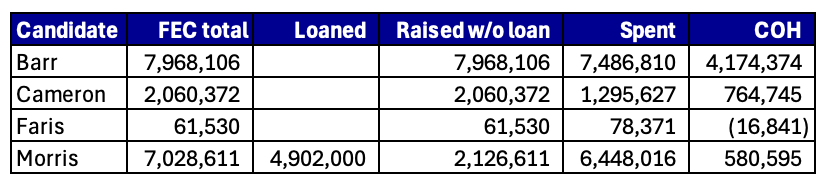
As you can see, Barr has spent almost as much as he has taken in, but he’s still sitting pretty in the cash-on-hand department. Cameron has been pretty frugal with his money, but I assume he’s going to do some advertising over these last few weeks with the money he has.
Now for the Democrats
If you started this analysis assuming Amy McGrath would be way out in front in the fund-raising department, you would be right. What may surprise you, though, is where her money has come from compared to her opponents.
Here’s the FEC top-line numbers:

McGrath has raised almost as much as the two top Repub candidates not named Barr. But, she’s also spent it prodigiously, and does not have a huge amount to throw at the wall in these few weeks before the primary.
For the KY-06 race, I did a graph on the funds raised without a loan. In this race, I think the numbers are clear: if it were only about money, McGrath would be the nominee.
Digging deeper
To quote what I wrote in the KY-o6 story:
The problem with just looking at the top-line numbers is that they are often skewed by things like loans and donations from PACs and other campaign committees.
One key metric is the number of donations from actual individuals, and not from those other sources. Along with the total number, it can be instructive to see how many came from within the state as opposed to other parts of the country.
In order to see what that looks like, I took out donations from anyone that wasn’t an individual donor, including donations from the candidate themselves. (Not the same as a loan, since it doesn’t have to be paid back.)
So, how many donations did each candidate receive, and what was the average donation, and where did they come from?
- Charles Booker – 204 donations; average donation of $794
- Amy McGrath – 2,113 donations, average of $405
- Dale Romans – 309 donations, average of $1,751
From these numbers, it’s pretty apparent that in the fund-raising department, Romans and to some extent Booker are benefiting from larger donations but fewer of them, while McGrath has gotten many more smaller donations.
But, as a stats nerd, I hate using averages, as they can be skewed by a few large numbers. So, let’s break out all the donations into four categories by the size of the donation (click on a graph to enlarge it):
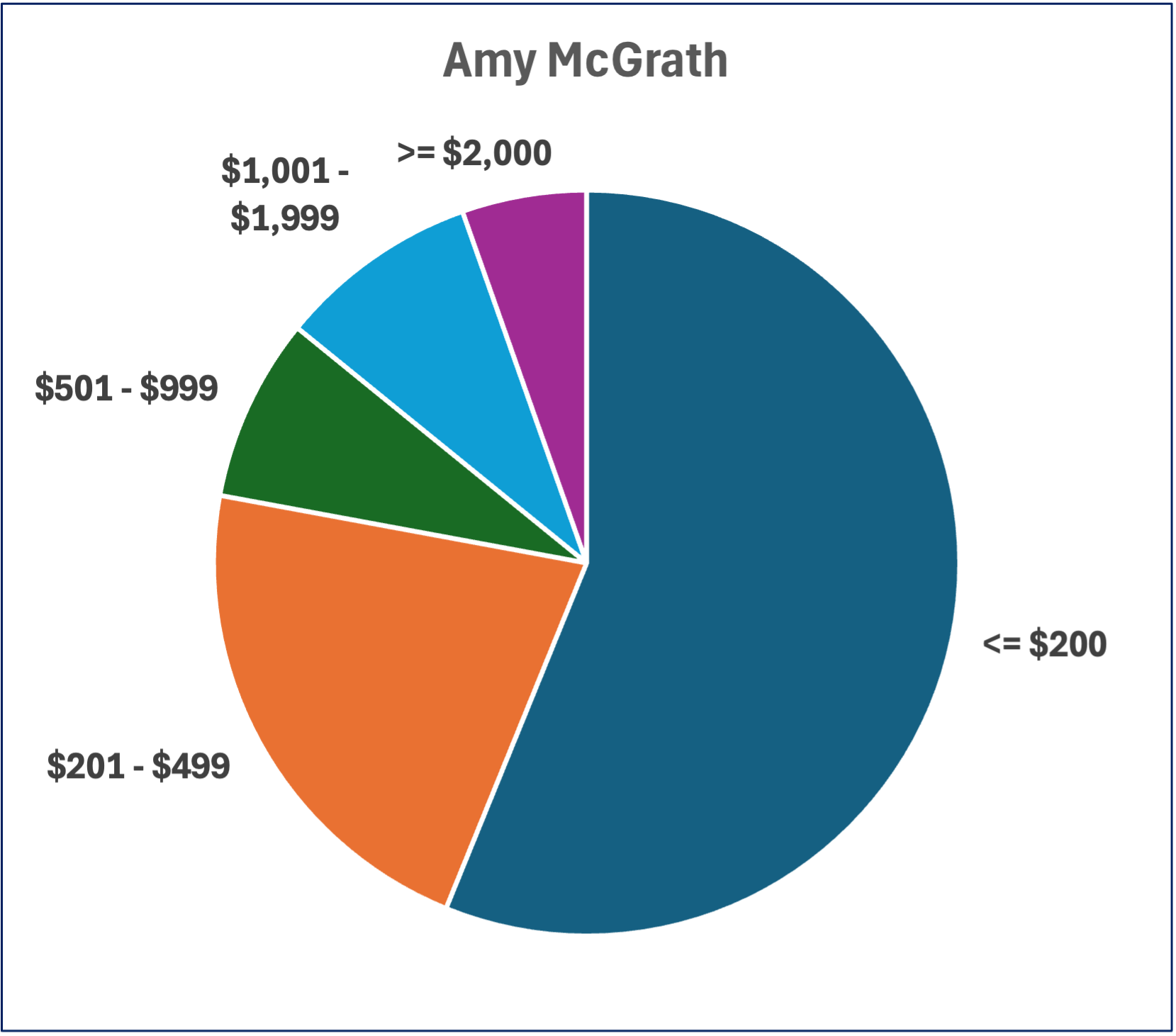
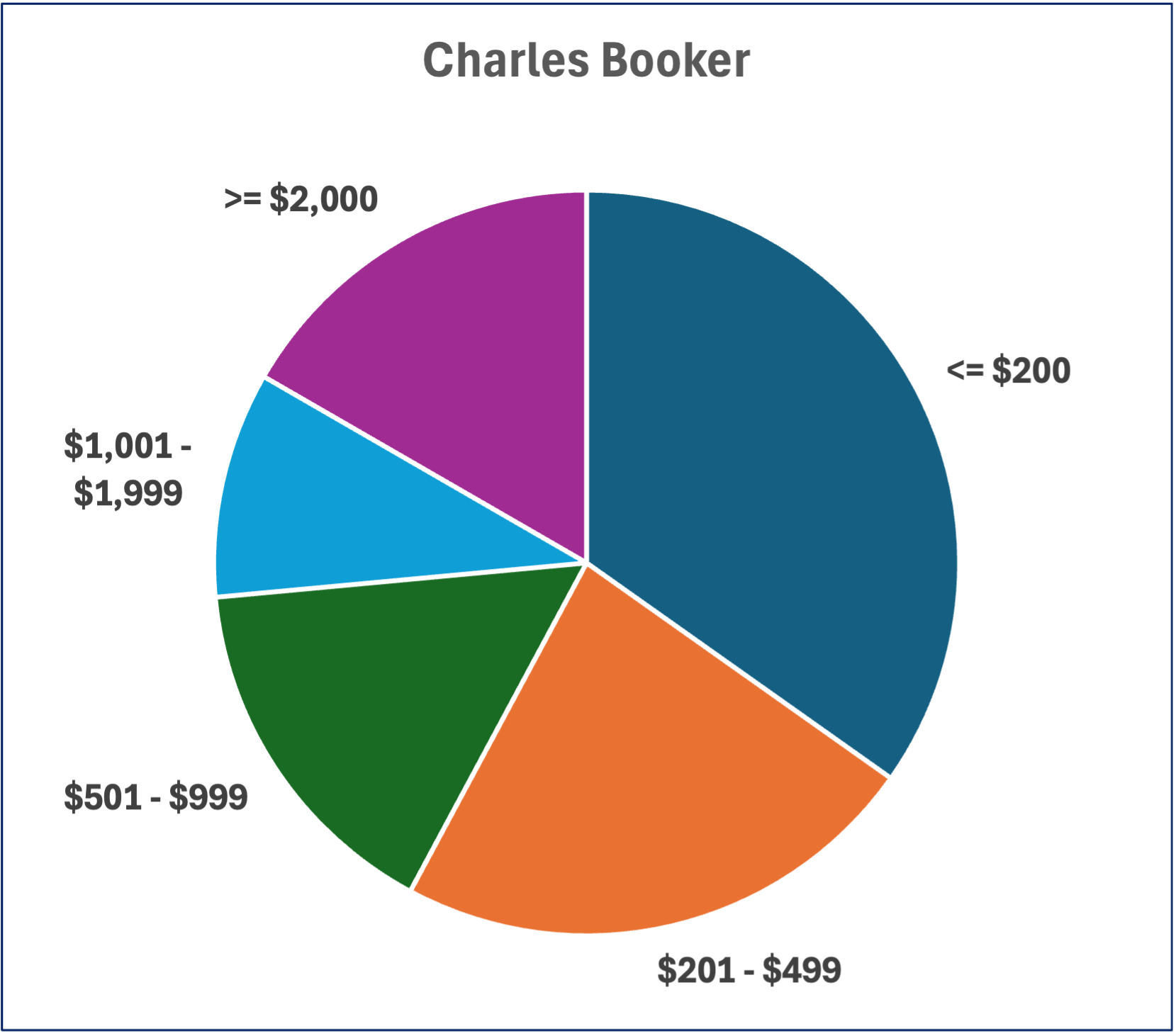
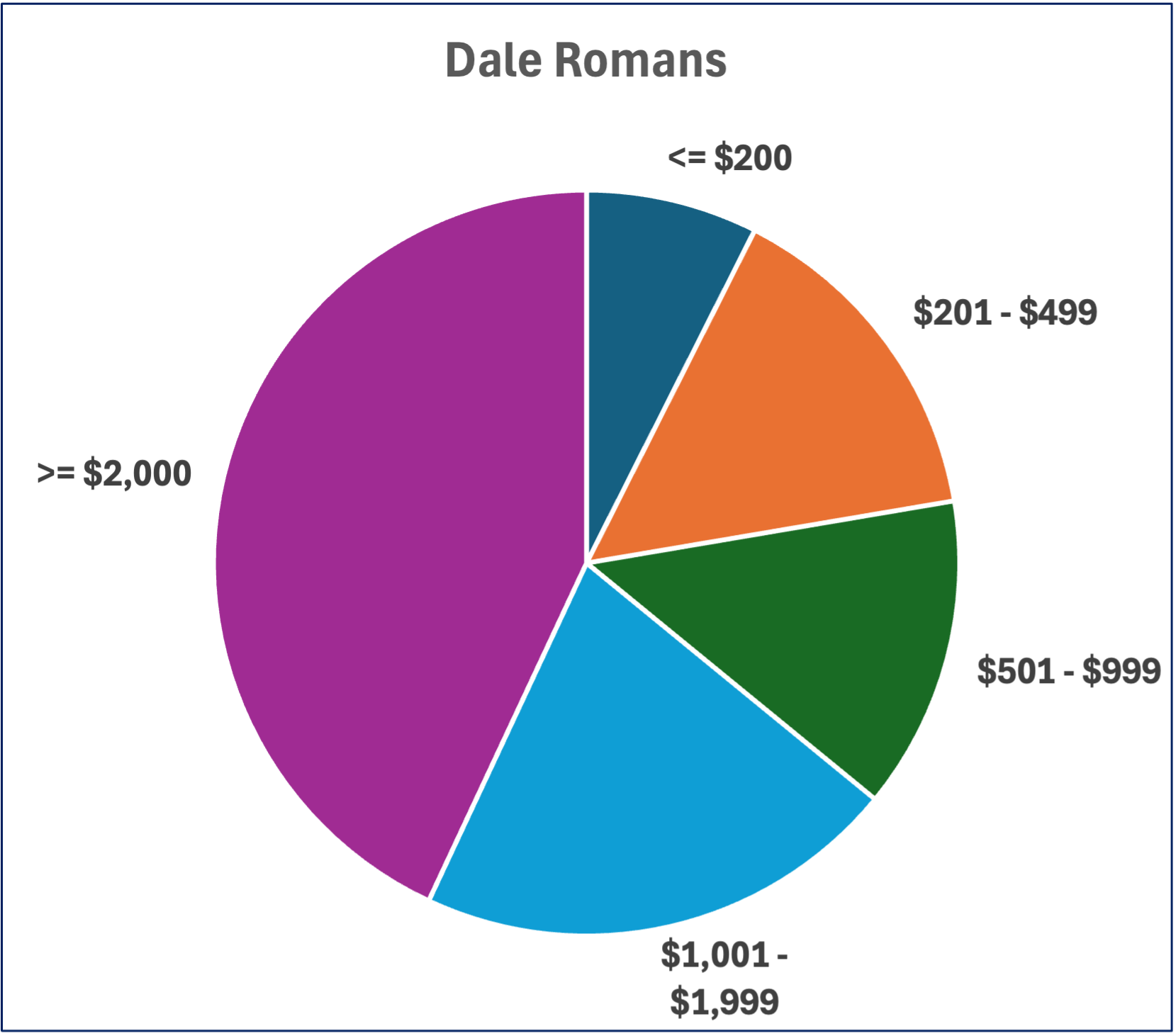
The graphs tell the tale:
- Romans is making bank on large donations, not only from Kentucky but also from Florida and New York. He has more donations over $2,000 than he does under $1,000. He has donations from 30 states.
- Booker has a larger percentage of smaller donations than Romans, but still shows a healthy chunk of large donations. Out of his 204 individual donations, 28 are for the max of $3,500. The bulk of his donations come from Kentucky, with California the only other state with a double-digit percentage of the donation count. He has donations from 23 states.
- The surprise in this, at least to me, is the national and grassroots nature of McGrath’s fundraising. Of her 2,000+ individual donations, over half are in the smallest category of $200 or less. Yes, she has a goodly number who have maxed out; but the vast majority of her fundraising is in the under-$1,000 range. And, check this out: She has donations from 49 of the 50 states. I suspect, if she were to win the primary, that national support would continue.
Conclusions
We all know that money isn’t the only determinant in an political race – but it surely is one of the main ones. And Andy Barr, and to some extent Daniel Cameron, seem to be in good shape heading into the primary. Most would pick Barr to win that election, and if he does, he’ll be good to go for the general. If Cameron wins, he’ll need to crank it up again to have enough money for the general. (And if Morris wins, he’ll probably just give his campaign another loan.)
On the Democratic side, it’s less clear. Booker leads in the polls I’ve seen, and if he wins, he is going to have to do something to improve his fundraising, or he will get wiped out by whomever wins the Repub side.
McGrath has a much better fundraising operation, and is able to pull from national donors to her previous campaigns. Will it be enough for her to catch Booker in the polls and in the voting booth? Doubtful, but possible.
What do you think? Anything surprise you, or does this analysis confirm what you already thought? Put your thoughts in the comments. And if you found this useful, please share it using the button below.
--30--
Comments