

A KYGA26 Haiku
The session is done.
No impeachment trial held
But still, bad bills passed.
** – ** – **
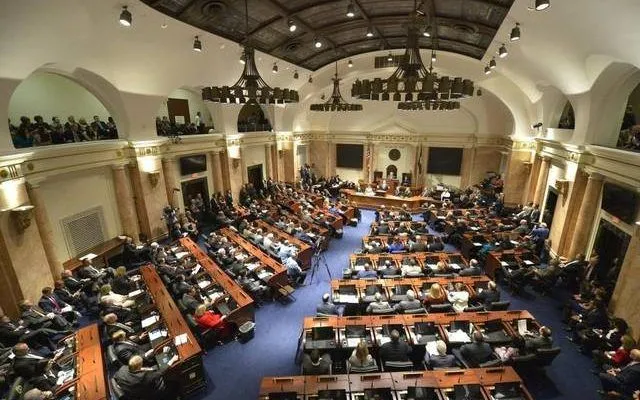
The General Assembly adjourned sine die on April 15 and it only took me a month to get a legislative wrap-up together for you. But here it is.
By my count, here’s what happened (but I don’t have a fact checker or editor or anything, so don’t quote me).
- 17 bills and one House Resolution became law without the Governor’s signature.
- 29 bills and one House Resolution became law over the Governor’s veto.
- Governor signed eight resolutions, 46 Senate Bills, and 94 House Bills into law.
This isn’t EVERY bill that passed, because who could read all that? I mean, I guess the legislature should be reading everything it passes. … But anyway, here are a lot of the priority bills, some of the more controversial bills, bills I found interesting, and some that we talked about on the show.
What became law with the Governor’s signature:
- HB 500: The two-year budget (though with some line-item vetoes)
- Education: The budget increases SEEK funding by 2% and freezes transportation contributions at $399 million. According to KY Policy, those figures represent SEEK funding 25% lower than 2008 levels when adjusting for inflation and $93 million below what the law requires for transportation. Higher Education was directly cut for all schools except Murray, Morehead, and Kentucky State (more on KSU later). Higher Education has been significantly cut over time, down 41% from 2008 levels with respect to inflation.
- Medicaid: The legislature enacted $6.2 billion in spending for Medicaid, more than the previous budget but not quite the $6.9 billion Beshear requested.
- HB 900: An earmark bill that appropriates nearly $1.8 billion in funds for special projects
- HB 2: Puts parts of federal Medicaid requirements into state statute, including work reporting requirements and co-pays, essentially rolling back expansion reforms.
- HB 4: Establishes a criminal offense of a grooming of a minor
- HB 5: To establish the Kentucky Community and Technical College System Prison Education Program within the Department of Corrections
- HB 7: School bus safety bill that would allow cameras to be installed to catch stop arm violations and establish a civil penalty for violations
- SB 2: Prevents administrator pay raises from outpacing teacher pay raises
- SB 5: Allows local school districts to participate in USDA school nutrition programs
- SB 46: To permit schools to use non-school bus passenger vehicles designed for 10, instead of 9, or fewer passengers
- SB 57: It allocates $25 million for a “Nuclear Reactor Site Readiness Pilot Program”
- SB 101: Strict expulsion bill and stiffer penalties for assault in the third degree for juveniles
- SB 122: Consider a defendant’s status as a caretaker of a dependent after conviction
- SB 137: To allow and specify requirements for a physician licensed to practice medicine in another country to obtain a provisional license to practice medicine in the Commonwealth
- SB 170: Establish a pilot program to be known as the Supporting Opportunities for Accountability and Restoration Program for children who are truant
- SB 172: Allows for the PSC to extend the recovery period to recover fuel adjustment costs
- HB 58: Restrict use of automated license plate readers; establish limitations on use and sale of data captured by automated license plate readers
- HB 67: Makes changes to last year’s electronic communications with students bill and fixes some of the biggest issues
- HB 134: Require the Cabinet for Health and Family Services to employ a health professional as a statewide sexual assault nurse examiner (SANE) coordinator
- HB 305: A person present at any part of a grand jury proceeding shall not knowingly record the proceeding or disclose any information gathered while present during a proceeding
- HB 422: Stricter sentencing for the violent offender statute. It bars violent felons from mandatory reentry supervision, increases life-sentence parole eligibility to 35 years, and requires consecutive sentences for multi-victim cases.
- HB 781: To require the cabinet develop and implement a Supplemental Nutrition Assistance Program
What became law without the Governor’s signature:
- SB 8: Changes membership and eligibility requirements of the Public Service Commission
- SB 73: A bill brought forth by MAHA supporters, SB 73 originally allowed home-based processors to produce tallow-based cosmetic products in accordance with the registration and regulation requirements set forth by the Cabinet for Health and Family Services.
- SB 104: Establishes a crime of impeding a first responder
- SB 195: Changed liability for alleged negligence against road contractors and design professionals. There were even greater tort reforms that were part of the original bill that did not make it into the final version, but I expect they will be brought up in future sessions.
- HB 6: A big childcare bill that does things like creates childcare microcenters, creates a childcare database, allows local governments to become a “Certified Childcare Community,” and creates assistance for childcare employees to access free childcare. Beshear is advocating for universal pre-k, and likely felt like a bill like this didn’t go far enough.
What became law over the Governor’s veto:
- SB 1: A new version of the old “SB 2” that targeted the JCPS School Board and changes the duties of the superintendent. The General Assembly added new language that they hope makes it constitutional.
- HB 1: to elect for the Commonwealth to participate in the qualified elementary and secondary education scholarship federal tax credit
- SB 4: Changes the makeup of the JCPS School Board
- HB 10: Curtails what a governor can do and what they must preserve during the last 12 months of their term
- SB 59: Expands the prohibition on using tax dollars to advocate for or against a public question on the ballot to prohibit using any resources, and to explicitly apply prohibition to school districts, regional educational cooperatives, and recalls on a ballot
- SB 77: Establish an ibogaine research fund to enter a public-private partnership with a drug developer to conduct a clinical drug development trial or trials related to the use of ibogaine for the treatment of opioid use
- Beshear’s concern is that this bill gives money to one specific company for treatment and also that it’s under the Department of Agriculture and not the Office of Drug Policy
- SB 173: to establish legislative review of changes to Kentucky’s state health plan
- SB 251: the Department of Corrections shall not be required to promulgate administrative regulations regarding the death penalty; establish that execution protocols and procedures may be prescribed by internal policy, memorandum, or another form of action
- This is seems like a great way to ensure more Eighth Amendment litigation!
- SB 263: Deals with “school of innovation” and creates an expedited waiver process for local board, creates a school of innovation pilot project, etc.
- Sounds like sneaky charter schools …
- HB 139: Big elections bill that makes several changes like judges can now discuss party affiliation, Board of Elections work with federal agencies to identify dead and noncitizens on voting rolls, AOC would have to produce lists of felons including those appealing convictions.
- HB 312: To issue provisional licenses to carry concealed firearms and other deadly weapons to persons who are 18 to 20 years of age
- HB 490: To allow for the removal of faculty members at public postsecondary education institutions for bona fide financial reasons
- Seems bad and ripe for misuse!
- HB 669: Cabinet for Health and Family Services shall determine for all children in the care and custody of the cabinet whether each child is receiving or eligible for earned federal benefits administered by the United States Social Security Administration or the United States Department of Veterans Affairs, including survivor or dependent benefits; require the cabinet to establish a program to be called the Success Sequence Savings and Disbursement Plan
- Beshear said the bill sponsor told the committee the Cabinet had not used federal funding for youth in foster care since 2012. That statement was false. Last year the Cabinet spent approximately $11.4 million in Social Security benefits to support youth in foster care and spent $67.5 million in federal funds from January 1, 2020 through October 15, 2025 toward the costs of foster care. He said “If The General Assembly takes away this much money from the Cabinet without appropriating new funds to make up for it, it will hurt the very foster children the bill is meant to support.”
- HB 904: raises the gambling age to 21, bans some prop bets, and prohibits horse racing tracks, sports wagering companies, and fantasy sports companies in Kentucky from being involved in a prediction market
- Beshear vetoed due to the way in which regulations would be promulgated for this bill, not because of the substance.
And that’s a wrap on #kyga26. On to primary election season!
Jazmin
Comments