

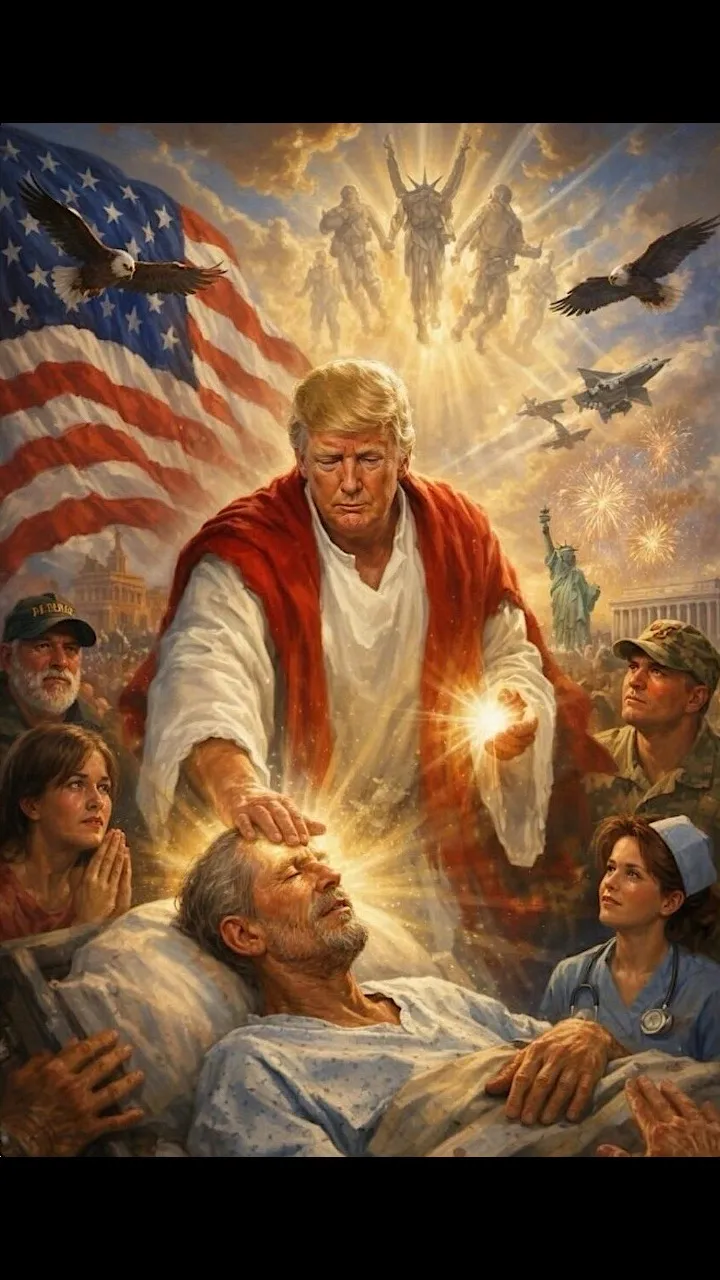
The image Donald Trump recently shared to his social media followers is not merely a piece of political art; it is a deeply disturbing manifestation of the idolatrous fusion of nationalism and messianic ambition that has come to define his political identity.
Draped in red and white robes, Trump is depicted placing his hands in a healing gesture over an ailing veteran, surrounded by a theatrical backdrop of celestial rays, ascending soldiers, military jets, the Statue of Liberty, and, bizarrely, some type of monster.
The implied message is unmistakable and profoundly arrogant: he is projecting himself not as a public servant or a political leader, but as a divinely chosen, patriotic messiah – the central figure of national and spiritual salvation.
When this visual rhetoric is viewed alongside his extraordinary and vitriolic statements regarding Pope Leo XIV, a deeply concerning pattern emerges.
Infuriated by the Pope’s moral opposition to war and violence, Trump lashed out on social media and to reporters, calling the pontiff “WEAK on crime” and “terrible for Foreign Policy.” In a display of breathtaking hubris, Trump even claimed credit for the papacy itself, declaring, “If I wasn’t in the White House, Leo wouldn’t be in the Vatican.”
These attacks on established spiritual authority, coupled with the imagery of self-exaltation, reveal a worldview where religious faith exists purely as a political tool to be manipulated, and then discarded the moment it challenges his power. Trump is not interested in leading or following a movement of faith; he is instead co-opting faith, positioning himself above the very principles that religious individuals are called to follow.
For Kentuckians, this represents a profound moment of reckoning.
As demographic data highlights, 77% of Kentucky’s adult population identifies as religiously affiliated, including a powerful 46% who are Evangelical Protestants and 11% who are Catholic. Historically, this religious identity has been a primary engine of our state’s conservative voting habits. However, we must confront the reality of the significant “attendance gap”: while 39% of Kentuckians claim regular church attendance, physical headcounts suggest that roughly 14% or fewer actually sit in the pews on a given Sunday.
With this background, it is also noteworthy that more than 80% of self-identifying white Evangelicals voted for Trump three times over eight years. A majority of Roman Catholics, between 50% and 55%, also voted for Trump in all 3 elections,
For many, being “religious” has evolved into a convenient cultural marker — a simple shorthand for social conservatism or MAGA affiliation — rather than a commitment to consistent adherence to a core set of theological convictions. This cultural identification is exactly what Trump exploits, substituting genuine faith for a shallow, politically expedient identity.
Today, our Catholic neighbors also face an acute and undeniable crisis of conscience. While the Catholic vote in Kentucky has increasingly swung toward conservative alignment on shared cultural issues, Trump’s latest tirade shatters the illusion that he is in any real way an ally of their faith.
By directly attacking Leo and demanding that the Pope “stop catering to the Radical Left” simply because Leo advocated for peace, Trump has demonstrated that he does not understand, respect, or support the Catholic faith or Christianity in general. He attacks the church the moment it refuses to bow to his political will.
Catholic Kentuckians are now forced to confront a president who demands that their historic faith in Christ and his church be subordinated to his earthly ego. Trump is forcing a choice between the historic teachings of their church and a leader who openly belittles it.
This is exactly the type of uncritical support the rhetoric in Trump’s messianic imagery relies upon. Trump depends on fear — fear of a more diverse nation and world bending towards justice — and offers his hollow promise to bend the world back toward favoring white Christians at the expense of others. Trump appeals to a superficial and dangerous cultural identity rather than the core tenets of Christian faith – principles like the recognition of our own sinfulness, a commitment to loving without limits, and daily work towards a more just and equitable world.
We cannot continue to excuse hubris and blasphemy in the name of political expediency.
The time has come for religiously affiliated Kentuckians to prioritize their proclaimed religious convictions over the comfortable, yet morally bankrupt, political alignment of the MAGA movement. Adhering to a true faith requires rejecting this kind of arrogant, self-aggrandizing portrayal and the dangerous conflation of faith with absolute political power.
The choice before us is no longer just between political parties; it is a stark, unavoidable decision between authentic faith and the all-consuming fealty to Donald Trump.
I call on all Kentuckians of all faiths, especially white Christians, to firmly reject Trump, his administration, and the entirety of the morally-bankrupt MAGA movement. Our faith demands integrity, courage, humility, and an unwavering dedication to the common good. Our faith cannot — and must not — coexist with the idolatrous worship of a politician.
--30--
Comments