

As I’ve discussed in each of my previous profiles on members of Congress, in the last decade political science research has confirmed what most Americans instinctively know: big money dominates US politics. Specifically, Barber (2016) and Kujala (2020) show that members of Congress represent their campaign donors rather than average citizens. What this means is that the Democratic Party represents rich people who are socially liberal and the Republican Party represents rich people who are socially conservative, but neither party represents average Americans.
For this week’s profile, I’m covering Republican representative Brett Guthrie (KY-2). He isn’t well known outside of Kentucky — or even in it, really — but he’s worth discussing for two specific reasons:
- He receives almost none of his campaign funding from average Americans through small individual contributions of $200 or less.
- He is arguably more sold out to the Pharmaceutical/Health Products industry (hereafter lovingly referred to as Big Pharma) than any other member of the House of Representatives. In particular, in the 2024 election cycle he set a new House of Representatives record for the most funding received from that industry in any election cycle.
This second point is particularly important. As a result of Trump’s “Big, Beautiful Bill,” roughly 200,000 Kentuckians are expected to lose Medicaid in the next decade, and Guthrie played an important role in making that happen. Now, some of the poorest people in one of the poorest states will have to decide whether to take on extra debt to cover their medical costs or go without medical care altogether.
Representatives like Guthrie — whose campaign is largely funded by rich people and corporations in the healthcare industry — must be voted out of office if we’re ever going to create a healthcare system that isn’t designed to extract profit from the poor and middle class. We spend more on healthcare than any other country in the world. And yet, our healthcare system is substantially worse than those of other high-income, developed countries like Germany, Australia, Canada, and the UK. As long as corrupt politicians like Guthrie are in office, our broken healthcare system cannot and will not be fixed. Voting him out of office should be an immediately pressing concern for Kentuckians.
Who is Brett Guthrie?
Brett Guthrie’s background is pretty generic. If you’re running for office as a Republican and you’re not an attorney, there’s a good chance your background is in the military or as a business owner. And — surprise, surprise — Guthrie has both of those backgrounds. He checked off the first box by attending West Point and serving as a Field Artillery Officer, and he checked off the second by joining his father’s business in Bowling Green, Trace Die Cast, upon his return. After jetting off to Yale for an MBA, Guthrie decided it was time for Kentucky to be represented by yet another out-of-touch rich guy.
After winning his first election to the Kentucky General Assembly in 1998, he spent the next decade … doing nothing, essentially. News search results for “Brett Guthrie” on Google include exactly two results between 1998 and 2008. Those two results include an obituary for his grandmother and an article about a ribbon cutting ceremony for a business in Bowling Green. It leaves you wondering what he was actually doing in Frankfort for a decade.
In any event, after splitting his time between working in the family business and doing nothing of note in the state legislature, he decided it was time to take his talents to Washington. Nobody asked for it, and we certainly didn’t deserve it. But running for office is a time-honored tradition for rich narcissists. And he had the elite backing to impose himself upon Kentucky’s 2nd congressional district.
Mr. Guthrie Goes to Washington
It often takes several election cycles for PACs to recognize the candidates who most serve elite interests. For example, the corporate Democrat I wrote about last week — Scott Peters — received less than 8% of his funding through PACs in his first election cycle and didn’t consistently receive more than 50% of his funding through PACs until his fourth election to Congress.
PACs realized Guthrie was their guy much more quickly. In his very first election to Congress in 2008, Guthrie received nearly 39% of his funding through PACs. An additional 54% of his funding came from large individual contributions of over $200. Overall, about 93% of his funding came through PACs or large individual contributions and less than 6% of his funding came from small individual contributions of under $200.
While his first election was overwhelmingly funded by the rich instead of the middle class, it only got worse from there. The table below summarizes his campaign finance data from his first election (2008) through 2024.
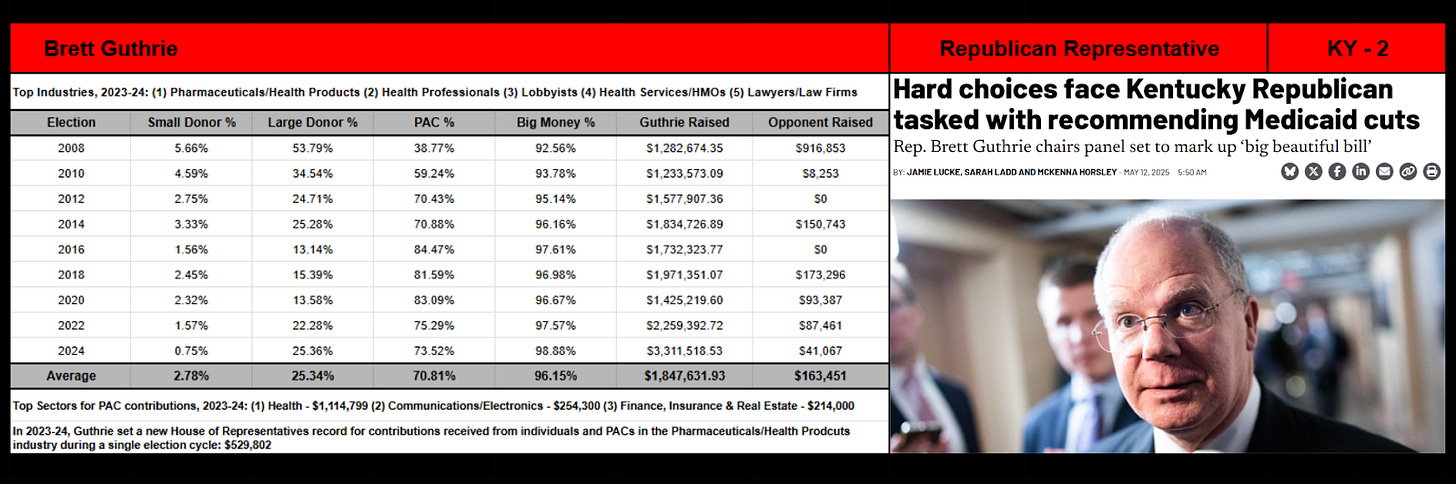
In the 2010 election his PAC funding increased from about 39% to 59%, and in each subsequent election at least 70% of his funding has come through PACs. In every single election, at least 92% of his funding has come through what I’m calling “Big Money %” — large individual contributions and PAC contributions. What’s worse, his “Big Money %” has increased over time, first reaching 95% in 2012 and then reaching an all-time high of 98.88% in 2024. At this point, almost all of Guthrie’s funding comes from the rich.
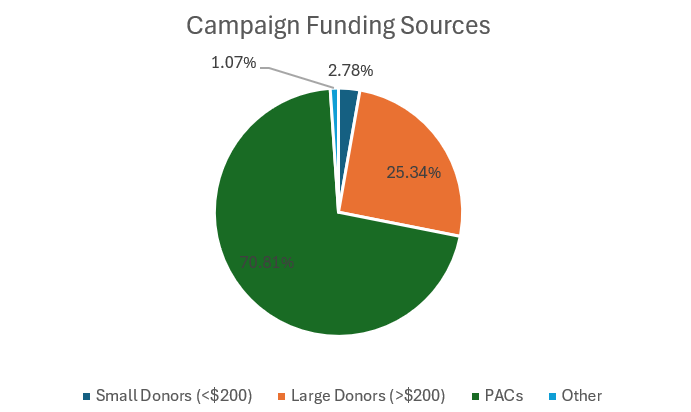
Meanwhile, his Small Donor % has only fallen from the already-paltry 5.66% seen in 2008. After falling to about 4.6% in 2010, it decreased to 2.75% in 2012. In the last 12 years, his Small Donor % has never once been higher than 3.4%. On average, across seven elections, only about 2.78% of his funding has come through small donations, while 25.34% has come from large individual contributions and 70.81% has come through PAC contributions.
I think it’s worth taking a moment here to visualize just how little funding Guthrie’s received from small individual contributions when compared to “Big Money” sources:
While the data we’ve seen so far makes it blatantly obvious that Guthrie doesn’t represent average Americans, it doesn’t tell us what elite groups he represents.
Who does Brett Guthrie represent?
While Guthrie’s financial support in 2008 came broadly from the rich, a specific subset of the rich has emerged as his most notable sources of campaign funding: the healthcare and insurance industries.
During his first re-election campaign in 2009-10, individuals and PACs that support people who profit by making healthcare more expensive had already identified Guthrie as a suitable vessel for their policy agenda. During that election cycle, he received about $105K from individuals and PACs associated with the Health Professionals industry (note: these PACs generally represent medical specialists who make over $250K per year). He also received about $57K from the insurance industry, $26K from the Health Services/HMOs industry, $25K from Big Pharma, and $25K from the Hospitals/Nursing Homes industry. Meanwhile, he only received about $57K from small individual contributions in that campaign.
To put this all in perspective, in 2010 for every $100 he received in small donations from average Americans, he also received about $422 from the healthcare and insurance industries, including:
- $186 from health professionals and their PACs
- $101 from the insurance industry
- $46 from the health services/HMOs industry
- $45 from Big Pharma
- $44 from the hospitals/nursing homes industry.
As bad as that was already, Guthrie’s campaign funding numbers have become even more grotesque over the years. As the amount of money he receives from those who profit from expensive healthcare increases, the share coming from the pharmaceutical industry has become especially large. The graph below reports the amount of funding Guthrie received from individuals and PACs Big Pharma in each election:
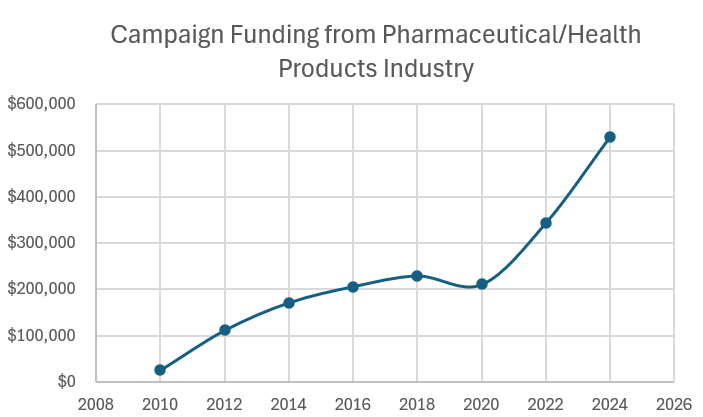
As the graph illustrates, Guthrie’s contributions from Big Pharma have increased across each election, with the exception of 2020 – and in the two elections since then, his contributions from that industry have spiked dramatically. In fact, in 2023-24 he set a new House record for the amount of money raised from Big Pharma: $529,802. To put this in perspective, the 2024 Big Pharma sellout runner-up in the House was Scott Peters (the subject of last week’s piece on campaign finance), with $343,640. The full House leaderboard for 2024 is available here.
Overall, in 2023-24, Guthrie received $24,748 in small individual contributions of $200 or less. At the same time, he received over $1.38 million from the healthcare and insurance industries. To put these numbers in perspective, for every $100 he received in small individual contributions he also received $5,593 from individuals and PACs in the healthcare and insurance industries including:
- $2,141 from Big Pharma
- $1,698 from health professionals and their PACs
- $905 from the health services/HMOs industry
- $436 from the hospitals/nursing homes industry
- $413 from the insurance industry
So, while Guthrie received about 4.2 times as much money from the healthcare and insurance industries as he did from small donors in 2010, in 2024 he received about 55.9 times as much from those industries as he did from small donors.
At this point, how could any person of sound mind trust Brett Guthrie to support making healthcare more affordable?
After receiving obscene funding from the healthcare and insurance industries in 2024, Guthrie delivered for them a major victory: The Big, Beautiful Bill. While almost all Republicans in Congress voted for that bill — which will kick about 10 million Americans off of Medicaid, including over 200K in Guthrie’s home state of Kentucky — Guthrie played a particularly important role as the chair of the House Energy and Commerce Committee. From that position, he oversaw the committee’s markup of the Big, Beautiful Bill, which just so happens to benefit the healthcare and insurance industries that bankroll Guthrie’s campaigns. Fancy that.
Guthrie doesn’t just refuse to try to make our healthcare system more affordable and accessible. He actively tries to make healthcare more expensive. When over 200,000 Kentuckians lose their Medicaid over the next 10 years, they’ll be forced to choose between paying for more expensive private health insurance or avoiding the doctor altogether. But the people whose interests in healthcare Guthrie really represents — those who work in Big Pharma or as health professionals making over $250K per year — will do just fine.
The Big, Beautiful Bill won’t begin to kick Americans off of Medicaid until 2027, just late enough for Republicans to avoid serious electoral consequences in the 2026 midterm elections. Democratic candidates in Kentucky and elsewhere, milquetoast as always, are clamoring to campaign on undoing Medicaid cuts that have not yet taken place, rather than actually fixing our broken healthcare system.
We spend far more money on healthcare than any other country in the world. And yet, our healthcare system performs very poorly when compared to our peers. We need to design a new healthcare system that prioritizes access and affordability while reducing costs. Political candidates should prioritize advocating for Medicare for All while simultaneously repealing the new Medicaid cuts. And voters should treat a candidate’s support for Medicare for All as a litmus test for whether they’re serious about fixing our healthcare system.
Don’t count on Brett Guthrie to support Medicare for All. He’s not interested in fixing our healthcare system. But he is interested in making it even worse than it already is – if that’s what you’re looking for.
--30--
Written by Peter S. K. Lynch, a political science instructor and writer. Cross-posted from his Substack.
Comments