

Editor's Note: This was written by a columnist in Virginia, but much of it applies to Kentucky as well.
You hear the phrase “right to work” in Virginia politics and it sounds harmless enough. Almost patriotic. Like something Norman Rockwell might’ve painted on the side of a feed store in 1952. Down South, though, politics has always had a talent for dressing hard truths up in pretty language.
Governor Abigail Spanberger touched off a political mess this month after vetoing legislation that would have expanded collective bargaining rights for public employees in Virginia. Labor groups were furious. Some Democrats acted shocked, though a few old union hands probably saw it coming the minute campaign season ended.
The bill would have allowed more public workers to negotiate over wages, benefits, and working conditions. Union supporters saw it as the first real crack in Virginia’s old anti-union labor structure. Business groups and Republicans argued it would drive up costs and hand too much power to organized labor. That debate has been bouncing around Southern politics for generations now, because Virginia’s labor history cannot really be separated from the South’s racial history.
Virginia adopted its “right to work” law in 1947, right in the middle of the segregation era. During that same stretch of time, Southern politicians were fighting labor unions, civil rights organizations, voting rights laws, and federal oversight all at once. Different issues maybe, but often the same politicians, the same business interests, and the same speeches warning people about “outside agitators” and threats to the Southern way of life.
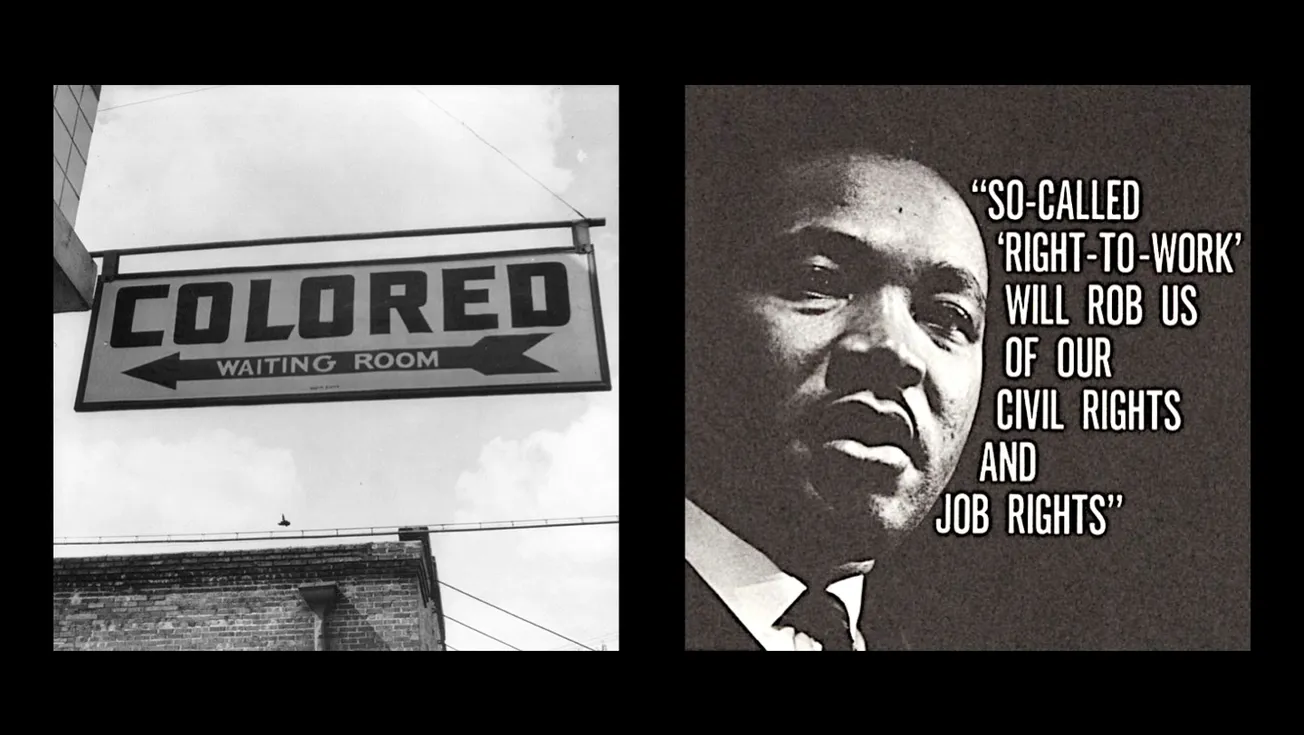
That’s why labor historians and civil rights advocates have long argued that anti-union laws in the South grew out of the same political soil as Jim Crow.
To understand that argument, you have to go back before the laws themselves. The phrase “Jim Crow” didn’t start in a courtroom or a governor’s mansion. It started on a stage in the 1830s when a white entertainer named Thomas Dartmouth Rice made money performing in blackface as a fictional character named Jim Crow. The act portrayed Black Americans as lazy and foolish, and audiences across America ate it up. The stereotype became part of popular culture long before it became part of law.
After Reconstruction ended, Southern states built segregation directly into government. Separate schools, train cars, restaurants, hospitals, neighborhoods, even cemeteries in some towns. Jim Crow became shorthand for an entire political system designed to keep Black Americans locked out of economic and political power after the Civil War.
Race sat at the center of it, but economics and labor sat close beside it. Southern elites understood something that scared them more than almost anything else: poor White workers and poor Black workers might eventually realize they had more in common with each other than with the bankers, industrialists, railroad owners, and coal operators making fortunes off their labor.
That possibility made organized labor dangerous.
A union hall had the potential to cut across racial divisions in ways politicians could not control. Coal miners asking for safer conditions underground did not care much about skin color once the mine roof started cracking overhead. Textile workers trying to feed their families usually had the same concerns whether they lived on one side of the tracks or the other.
Southern political leaders recognized that threat early. Anti-union campaigns often borrowed the same language used during segregation fights. Union organizers were painted as radicals, outsiders, troublemakers, and enemies of stability. “Right to work” laws eventually became one of the South’s strongest tools against organized labor. Supporters sold the idea as individual freedom. Critics argued the laws weakened unions by allowing workers to benefit from union contracts without helping financially support the unions themselves.
Corporations loved the arrangement because weaker unions usually meant lower wages, fewer strikes, and cheaper labor. Over time, much of the South marketed itself to industry as a low-wage, union-light alternative to Northern manufacturing states.
That history still hangs over modern Southern politics whether politicians want to admit it or not. Which is why Spanberger’s veto hit such a nerve with labor supporters across Virginia. Many union voters believed Democrats were finally serious about rolling back parts of the old anti-labor system that had dominated Virginia politics for decades. Instead they got a reminder that campaign speeches and governing are often two very different things.
There’s an old mountain saying that a mule can kick you hardest right after you fed it. More than a few labor Democrats in Virginia are probably thinking about that line this month.
--30--
Written by John Peace, a fifth-generation farmer from Big Stone Gap, Virginia, and a two-time Amazon best-selling author. Cross-posted from the Rural Route Newsletter.
Comments