


Every time I whistle, I think of Winston Churchill.
Now, you might be thinking, “you’re such a nerd, Rachel!
And you’d be right!
The reason I always think of Winston when I whistle is that he hated it. Actually, hate is wholly inadequate. It drove him insane! Irrationally so.
But that’s not the only time I think of Winston Churchill, an imperfect hero with shameful legacies in British imperialism and misogyny, although the latter changed quite a bit after he worked with a room full of women plotting the RAF planes and the Battle of Britain.
Winston Churchill saved the West from fascism, and he did it for a very long time alone.
I think of Churchill a lot because he saved Britain from certain death when there was no reason to have any hope.
Let me explain:
Hope is easy when there is little to fear.
It is much harder when the facts are terrible – and getting worse.
Real hope is not optimism. It is not reassurance. It is not the belief that things will work out. Real hope is what remains after denial fails, after warnings are ignored, after catastrophe arrives anyway. It is the discipline of refusing to surrender judgment, purpose, or will when the night finally comes.
If anyone in the twentieth century had reason to abandon hope, it was Winston Churchill.
For nearly a decade before Europe descended into war, Churchill tried — relentlessly, obsessively, at enormous personal and political cost — to prevent it. Throughout the 1930s, as Adolf Hitler rose to power in Germany, Churchill stood in the House of Commons issuing warnings that few wanted to hear. He was not guessing. He was not speculating. He was warning.
Germany was rearming in open violation of the Treaty of Versailles. Aircraft factories multiplied. Production surged. Military capacity expanded at a pace that could not be explained away. Churchill understood something that much of Britain’s political class, trapped in the virulent isolationism that was a byproduct of WWI preferred not to confront: the nature of war itself had changed.
“The air is no longer a frontier,” he warned Parliament in 1934. “It is a highway.”
Britain, an island nation, would live or die by what happened in the sky. Yet rearmament was treated as provocation. Preparation was dismissed as pessimism. The trauma of the First World War still hung heavily over British society, and peace — almost any peace — felt like wisdom. Churchill, who did not want war at all, was branded a warmonger for insisting that the only way to avoid catastrophe was to prepare for it.
Again and again, he pointed out what was already plainly visible. In 1935, he reminded the House that “Germany has repudiated the disarmament clauses of the Treaty of Versailles,” adding pointedly that the fact “cannot be ignored, however much we may wish to do so.” But Britain did wish to ignore it. Delay felt safer than confrontation. Negotiation felt more civilized than rearmament. Comfort was chosen over clarity.
By 1936, Churchill’s warnings grew darker. The window for easy choices was closing.
“The era of procrastination, of half-measures, of soothing and baffling expedients, of delays,” he told Parliament, “is coming to its close. In its place we are entering a period of consequences.”
Those words were not rhetorical flourish. They were a forecast like this speech in 1938: Britain Must Rearm
The cost of speaking plainly was isolation. Churchill was sidelined within his own party, treated as an embarrassment, a relic of an older, bloodier age. The clever men assured one another that Hitler could be satisfied, that grievances could be managed, that Europe could be stabilized through concession.
Munich shattered that illusion. In 1938, when Prime Minister Neville Chamberlain returned from Germany proclaiming “peace for our time” after surrendering the Sudetenland, Churchill delivered the judgment history would confirm:
“You were given the choice between war and dishonour. You chose dishonour, and you will have war.”
Churchill had tried to stop the catastrophe. He failed. Being right did not save Europe.
By September of 1939, the consequences arrived with terrifying speed. Poland fell. War was declared. France — once the strongest army on the continent — collapsed in weeks. Nazi Germany now controlled nearly all of Western Europe. Britain stood alone, an island separated from occupation by a narrow strip of water. Just eighty miles of Channel lay between survival and subjugation.
It was at this moment — when the damage was already done — that Winston Churchill was finally called to lead.
He became Prime Minister just days before Dunkirk.
On the beaches of northern France, hundreds of thousands of British and Allied soldiers were trapped, awaiting capture or annihilation. Churchill hoped to rescue forty-five thousand by asking all small craft to head to Dunkirk. What followed was a Churchill-led miracle born of desperation: civilian boats crossing under fire, pilots fighting overhead, weather holding just long enough. More three hundred and thirty thousand men were pulled from the sands.
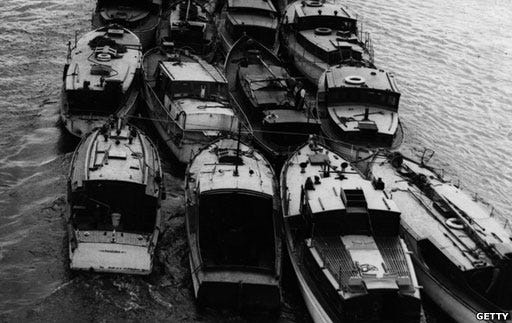
The nation rejoiced – but Churchill, understanding what was coming, refused to oversell Dunkirk:
“Wars are not won by evacuations,” he warned. The army had been saved, but the war had not. And worse still, invasion now loomed.
Inside Churchill’s own cabinet, the old appeasement instinct returned. Perhaps Britain could negotiate? Perhaps Mussolini could mediate"? Perhaps survival under terms was better than destruction. Appeasement, reborn in a darker hour, pressed hard when Britain was weakest.
Churchill ended the discussion.
“If this long island story of ours is to end at last,” he told them, “let it end only when each one of us lies choking in his own blood upon the ground.”
This was not bravado. It was clarity. It was met by loud cheers of the entire war cabinet. Britain had a leader at last!
Churchill understood that surrender does not remove fear. It merely trades fear for subjugation.
Days later, he stood before Parliament and spoke words that would echo through history — not because they promised safety, but because they told the truth.
He was not telling Britain that invasion would not come. He was telling them who they would face it with full fury.
Then the skies filled with war.
The Battle of Britain was not an abstraction. It was nightly terror—sirens, flames, bodies pulled from rubble. The Luftwaffe bombed cities not merely to destroy infrastructure, but to break morale, to convince civilians that resistance was futile.
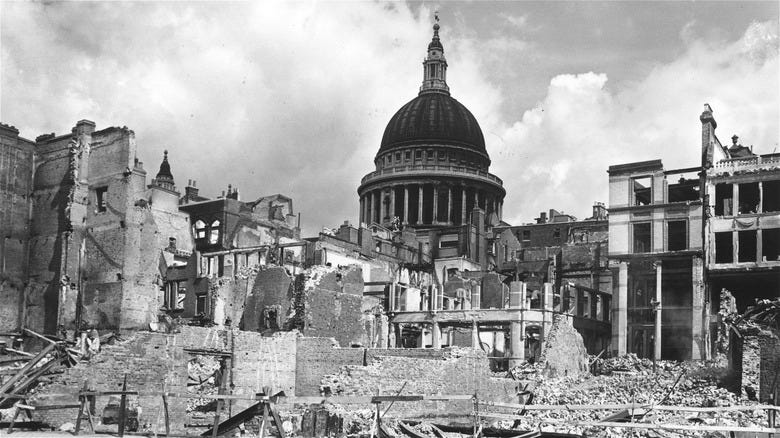
It failed.
Britain endured because a small number of pilots—young men flying exhausted machines—held the line against overwhelming odds. Churchill named the truth plainly:
“Never in the field of human conflict was so much owed by so many to so few.”
Britain did not survive by appeasing Hitler. It survived by refusal.
Even when invasion faded as an immediate threat, the terror did not end. V1 flying bombs came first, then V2 rockets—the world’s first rockets. Supersonic weapons falling without warning, impossible to intercept. Thousands were killed. No defense existed. There was only endurance.
They say if you could hear the V-2 you are not its target. Gallows humor to deal with a threat you could do nothing to protect yourself from.
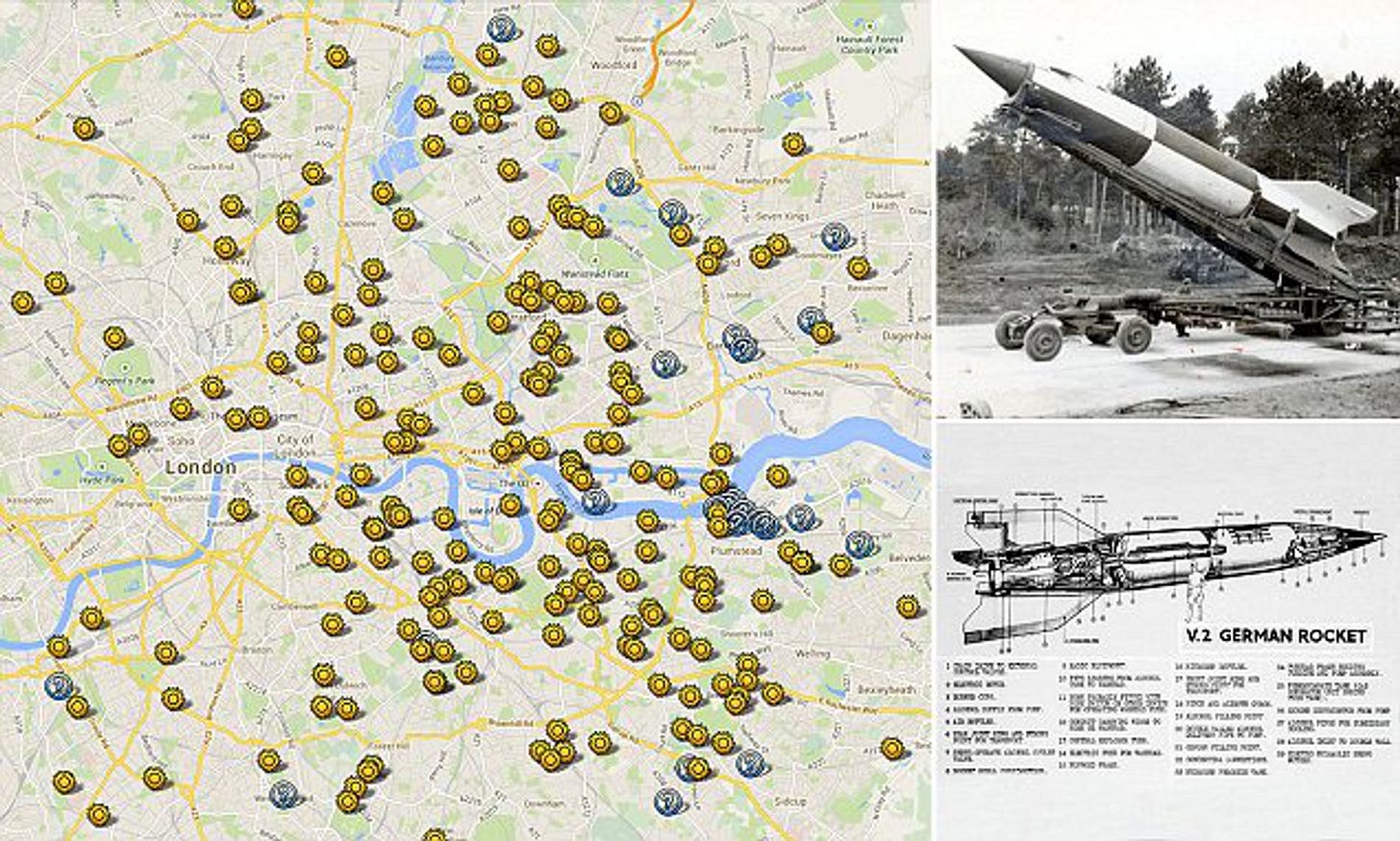
And the British endured that too.
Keep in mind, all of this was before Pearl Harbor, which ended American isolation.
History makes victory seem inevitable. It was not.
Britain lived through a year when defeat was the rational expectation. What changed the future was not optimism. It was leadership forged in years of lonely warning, tested under fire, and sustained without illusion.
Churchill’s hope was never a feeling. It was a discipline. A flame kept alive by truth, by preparation, by refusal to look away—first when doing so was unpopular, and later when it was terrifying.
He tried to stop the war. He failed.
And when failure came, he refused to surrender to hopelessness anyway.
That is what hope looks like in a hopeless world.
--30--
Written by Dr. Rachel Bitecofer. Cross-posted from The Cycle on Substack.
Comments