

Leon Todd, my fellow Carlisle County Democrat and union retiree, has a message for union members who believe Republicans who claim they’re the born-again working-class party.
“If you ever worked at a clock-card job, you should vote Democratic because the Republicans don’t want anybody to get paid a good wage, have good benefits, and have any rights at work,” said the 77-year western Kentuckian who worked at the old Continental-General Tire plant near Mayfield.
Todd is proud to tell you he belonged to United Steelworkers Local 665, which was United Rubber Workers Local 665 until 1995 when the URW merged with the Steelworkers.
It’s no secret that unions mainly endorse Democrats for public office, but not because of the party label. Unions endorse candidates who consistently support unions. And those candidates are usually Democrats, by a wide margin.
Want proof? Check out the most current AFL-CIO online Legislative Scorecard.
On a scale of 0 to 100 percent, the AFL-CIO rates all U.S. representatives and senators on where they “stand on issues that affect working people’s rights, jobs, pay, benefits, quality of life and more. Each rating reflects how often each elected official voted in accordance with an AFL-CIO vote recommendation on a House-wide or Senate-wide matter.”
The latest scorecard is from 2025 and is based on legislation the federation considered especially important to workers and their families. The AFL-CIO scored House members on 13 bills and senators on 9 bills. The scorecard also includes a “lifetime” percentage based on votes legislators have cast since they were first sworn in.
The House
- In 2025, the average score for a House Democrat was 97%.
- For House Republicans? 1%
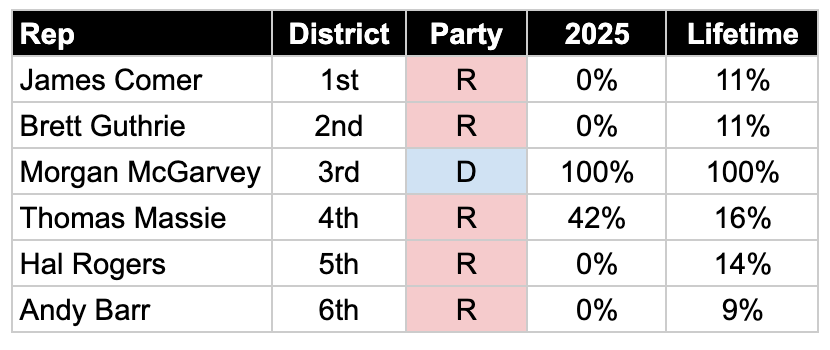
So, how did Kentucky’s six congressmen score?
The Senate
- In 2025, the average score for a Senate Democrat was 99%.
- For the average Senate Republican? 4%
So, how did Kentucky Republican Senators Mitch McConnell and Rand Paul score?

But note this: Paul and Massie’s 2025 scores are misleading. Both have consistently been anti-labor. Paul has sponsored-and Massie has co-sponsored-national “right to work” bills. Their lifetime scores are more reflective of their positions on other union issues.
The scorecard doesn’t say what percentage is considered failing. It was below 60 percent in the classes I took at Murray State University and the same in the history classes I taught at West Kentucky Community and Technical College in Paducah.
And, if you look up other state delegations, you’ll see a similar chasm between Republicans and Democrats.
Like this? Then share it!
What about Frankfort?
The Kentucky State AFL-CIO doesn’t post its own legislative scorecard. But voting patterns in Frankfort closely mirror those in Washington.
In 2015, Republican Gov. Matt Bevin was elected on an openly anti-union platform. The next year, the GOP flipped the House — the Senate was already Republican — and it was open season on organized labor.
In 2017, with the governor cheering them on, the Republicans lost no time passing bills making Kentucky a “right to work” state, repealing the prevailing wage on state-funded construction projects, and making it harder for some unions to collect dues through payroll deduction.
Every Democratic legislator voted against the three union-busting bills, except one – a House member who backed the bill that axed the prevailing wage. Only a handful of Republicans sided with the Democrats in opposing the three bills.
Since, with even larger super-majorities, Republican lawmakers have worked to gut the state workers compensation, unemployment insurance, and worker safety and health programs. The super minority Democrats have opposed the anti-worker bills and Democrat Gov. Andy Beshear, a Democrat, has vetoed them all – to no avail.
In the last session of the legislature, Democrats in the Senate and House introduced bills to repeal “right to work,” thus offering Republicans a chance to prove they’re the working-class party. Neither bill went anywhere.
Has it always been like this?
To be sure, on labor issues, the divide between Democrats and Republicans wasn’t always Grand Canyon-wide. That’s notably true in the late 19th-century when the country rapidly industrialized and millionaire business owners and financiers routinely bought off politicians of both parties.
They got what they paid for. Most Republicans and most Democrats were happy to do the plutocrats’ bidding, such as by refusing to pass laws to protect workers against the rapacious greed that naturally stems from unfettered capitalism, and by keeping off the books laws that guaranteed workers’ rights to organize and bargain collectively.
Union-busting was bipartisan. In 1877, President Rutherford B. Hayes, Republican, dispatched U.S. soldiers to help break the Great Railroad Strike. In 1894, Democratic President Grover Cleveland sent in federal troops to crush the Pullman Strike.
At the same time, many Republican and Democratic governors used state militia to smash strikes. Mayors of both parties did likewise with cops. No wonder a lot of union men and women said “a pox on both your houses” and flocked to short-lived labor and pro-labor parties.
American labor’s big shift toward the Democrats started in the 1930s when Franklin D. Roosevelt was president. “If I went to work in a factory, the first thing I’d do would be to join a union,” he famously said. The CIO made a poster featuring the quote.
Union members didn’t ally with the Democrats because they were Democrats. They got behind FDR and his New Deal Democrats because they wanted to help labor. On the other hand, most Republicans smeared unions as “un-American” and even “Communist.” White supremacist Southern Democrats also opposed unions because they feared union would undermine Jim Crow segregation. They hated the idea that in a union, everybody was equal.
FDR’s Depression-fighting New Deal program put millions of jobless Americans to work. Roosevelt boosted unions more than any other president had. The landmark 1935 Wagner Act guaranteed workers the right to organize and required employers to recognize duly voted-in unions.
Yet while the Democratic Party is clearly America’s pro-labor party, it’s not a labor party. I wish it were. I still hope that someday my party will look more like the labor, social democratic, and democratic socialist parties in Western Europe. All of them either grew out of, or are deeply rooted in, trade unionism.
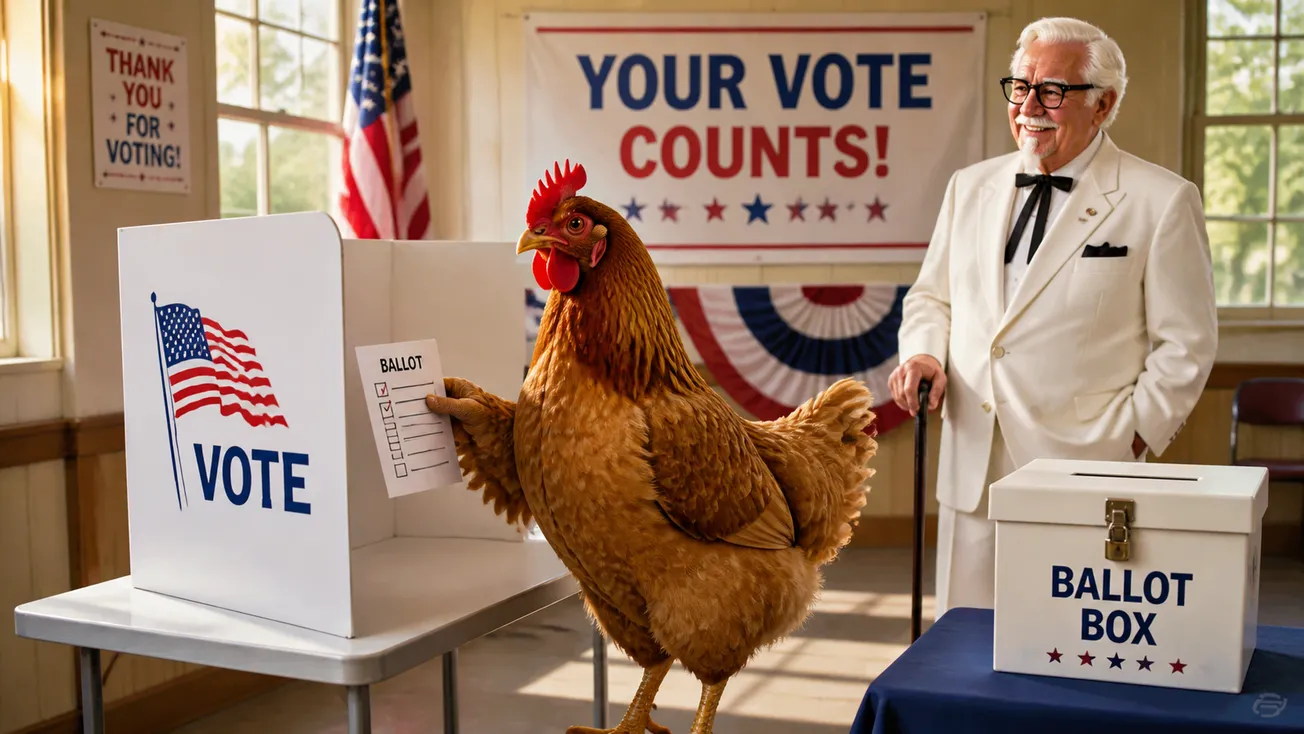
For now, though, Leon Todd is right. So is a sign that hung in a Paducah union hall in 1980: “A union member voting for a Republican would be like a chicken voting for Col. Sanders.” The sign is just as timely today with the most anti-union president since Herbert Hoover in the White House.
“A union member voting Republican would be like a rabbit looking forward to rabbit season,” said longtime Democratic state Rep. J.R. Gray. From Benton, Gray, a local International Association of Machinists union official, was one of organized labor’s best friends in the legislature. He also championed workers as state Labor secretary.
“History will tell you that the Democrats ramrodded every meaningful piece of legislation for the benefit of working people,” he once told me. Gray was a staunch Democrat, who got his history right.
--30--
Comments