


Via press release
A new report on educator pay in America reveals that despite growth in educator pay last year, chronic problems plague educators, including low wages and a lack of professional respect, even as national “Teacher Appreciation Week” kicks off.
The annual report released by the National Education Association shows that despite the average public school teacher salary rising nationally by 3.5%, pay has failed to keep up with inflation over the past decade. Adjusted for inflation, teachers earn about 5% less today than they did 10 years ago. Kentucky teachers have not received an across-the-board pay raise since 2008.
The data released includes Rankings and Estimates, a report NEA has produced since the 1960s and widely cited as an authoritative source on average teacher salaries and per-student expenditures. NEA’s Teacher Salary Benchmark Report provides information from over 12,000 school districts on starting teacher salaries and salaries at other points of the teaching career continuum. The Education Support Professional Earnings Report offers a pay breakdown for school support staff, also known as education support professionals, working in K-12 public schools and higher education. NEA’s Higher Education Faculty Salary Analysis examines full-time faculty and graduate assistant salaries at the national, state, and institutional levels.
Why it matters in Kentucky
Teachers in Kentucky are the backbone of our democracy. As one of the most under-appreciated and underpaid professions, we are seeing a shortage of educators, jeopardizing the future of our children. In 2025, there were more than 2,421 school vacancies across Kentucky, according to a Kentucky Department of Education report. Data shows that over the past year, little has been done to improve teacher pay in Kentucky. When educators don’t feel supported, especially financially, it becomes nearly impossible to address the teacher shortage plaguing the commonwealth.
Data highlights and trends
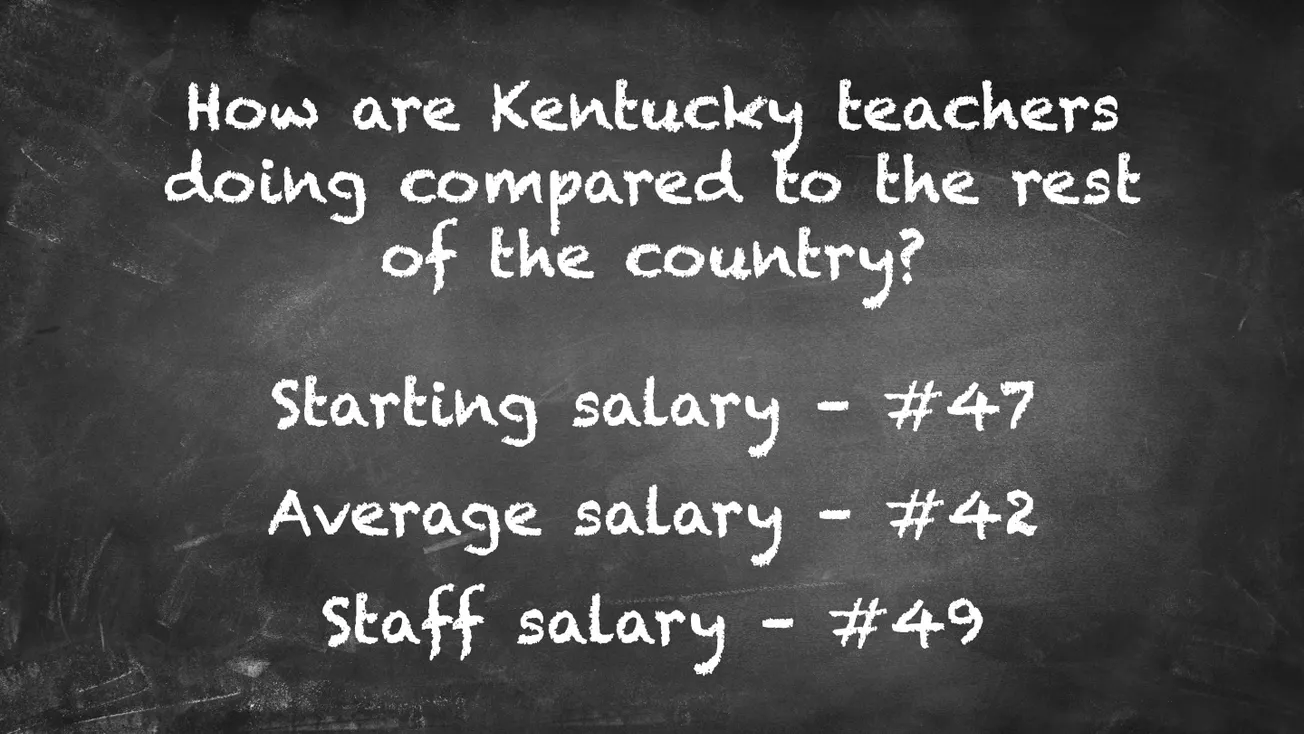
- The average Kentucky public school teacher salary increased 3.7% from the previous year to $60,594, but nationally Kentucky ranks 42nd in the nation, same as last year.
- The average beginning teacher salary rose 4.2% in Kentucky to $41,901, ranking 47th nationally.
- Classified support staff (bus drivers, janitorial workers, cafeteria services, administrative staff) make, on average, $29,312 per year in Kentucky, a 4.2% increase from the previous year, but a ranking of 49th across the country.
- Competitive pay among bordering states is plaguing the teaching profession in Kentucky. Of the seven states surrounding Kentucky, only West Virginia and Missouri rank lower at 47th and 49th, respectively, on average teacher salary.
- SEEK funding (Support Education Excellence in Kentucky), which is the funding formula the legislature uses to provide resources to schools per student, is below 2008 levels in Kentucky, when adjusted for inflation.
- Teacher pay gap. Compared to other college-educated professionals with similar experience, teacher salaries are 27% lower than those of their similarly educated peers, according to and Economic Policy Institute report.
- The union advantage: Teachers earn 24% more on average in states with collective bargaining.
“The irony of seeing the continued low salary rankings for Kentucky’s educators in the same week we are celebrating teacher appreciation week is not lost on our KEA members, and should not be lost on the legislators and school boards who fund our public schools,” said KEA President Joel Wolford. “Every school district across the commonwealth faces shortages of teachers, substitutes, bus drivers, custodians, and office staff. Properly investing in our educators’ pay could help remedy this critical shortage and make Kentucky a competitive destination for educators working in our neighboring states. Until then, Kentucky will continue to struggle with fully staffing our public schools.”
--30--
Comments