

There’s a largely unknown Kentucky connection to Solidarność, the grassroots trade union movement that ultimately led to the demise of Poland’s communist regime.
A big Solidarność” (“Solidarity” in English) banner, a gift from Lech Walesa, the Nobel Peace Prize-winning leader of Solidarność, hangs in the Waddy home of Bill Londrigan, Kentucky State AFL-CIO president-emeritus.
“Lech Walesa gave the banner to Jerry Hammond,” Londrigan explained. “When he passed [in 2002], his widow, Mary Lou, gave it to me.”
Hammond, from Versailles, was secretary-treasurer of the Kentucky State Building and Construction Trades Council. Mary Lou Hammond died this year. Both were among Londrigan’s close friends.
Forty-five years ago this month, Solidarność became the first independent trade union officially recognized by a Soviet satellite state. A decade later, communism fell in the Soviet Union and eastern Europe.
Recognition of the union on Aug. 31, 1980, followed a risky general strike along Poland’s Baltic seaboard. Walesa, 37, and other union officials had called the strike almost three weeks earlier.
Soviet troops had crushed rebellions against communist rule in East Germany in 1953, Hungary in 1956, and Czechoslovakia in 1968. In 1970, Polish police and soldiers had killed 45 shipyard workers during massive protests over the rising price of food and other necessities while wages remained unchanged.
Solidarność demanded that the government allow free trade unions and legalize strikes. After the government gave in, three dozen unions united under the Solidarność banner. Led by Walesa, the union grew rapidly; membership peaked at more than 10 million in 1981.
While Moscow predictably denounced Solidarność, it didn’t use military force to break the union.
“The establishment of new independent trade unions in Poland marks a major and historic step towards a more pluralistic form of communism,” wrote Michael Dobbs in The Guardian, a British newspaper, on Sept. 1, 1980. “Never before has a Soviet Bloc country ceded the right to represent the working class to an independent organisation.”
Walesa, now 81, became a hero to Londrigan and millions of other trade unionists and supporters of democracy worldwide. “He was a rank-and-file shipyard electrician who literally changed Poland from a communist state to a democratic country,” Londrigan said.
After recognizing the union, the Polish government, increasingly pressured by Moscow, moved to crush Solidarność in its infancy. But the union’s fortunes greatly improved after reformist Mikhail Gorbachev became head of the USSR.
Influenced by Gorbachev’s program of glasnost (openness) and perestroika (restructuring), the Polish government finally recognized Solidarność as a legal political party. As a result, Solidarność defeated the Polish Communist Party in a landslide and Walesa was elected president in 1990.
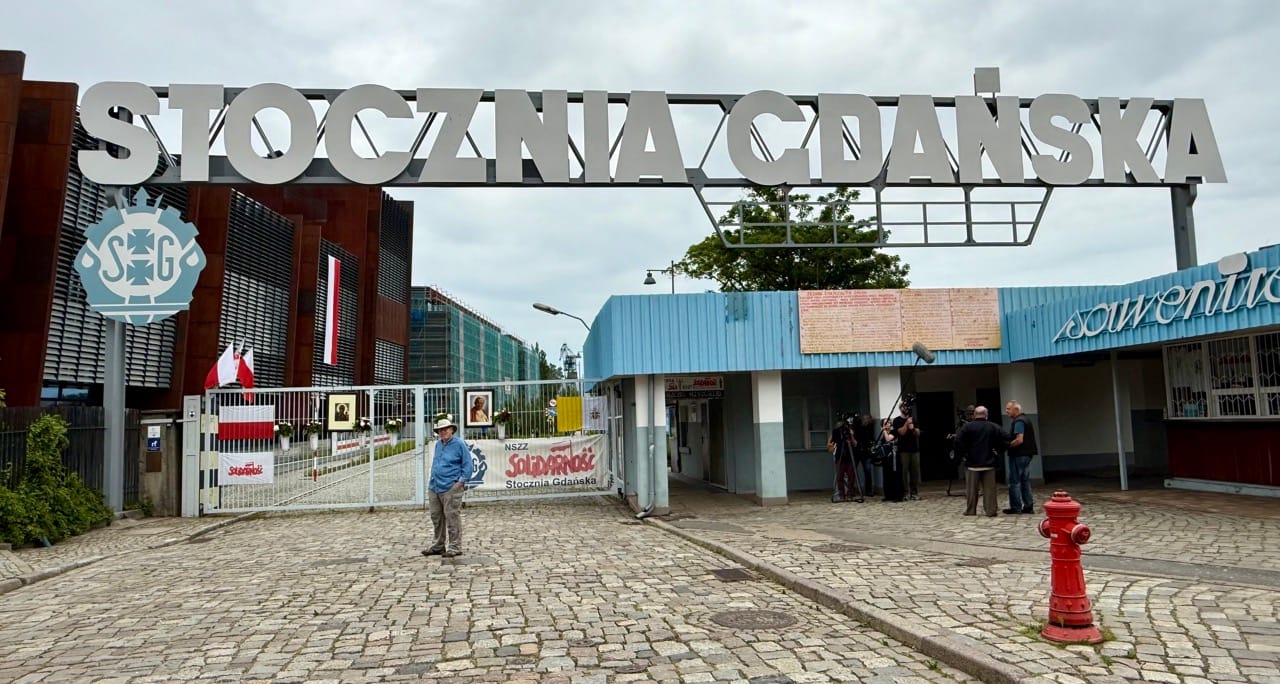
Arrested several times for his union actions, Walesa worked in the old Lenin Shipyard in Gdansk. The European Solidarity Centre was built on part of the site. The Centre “is a modern cultural institution that perpetuates the memory of our greatest civic success – the victory of Solidarity,” says the centre’s website.
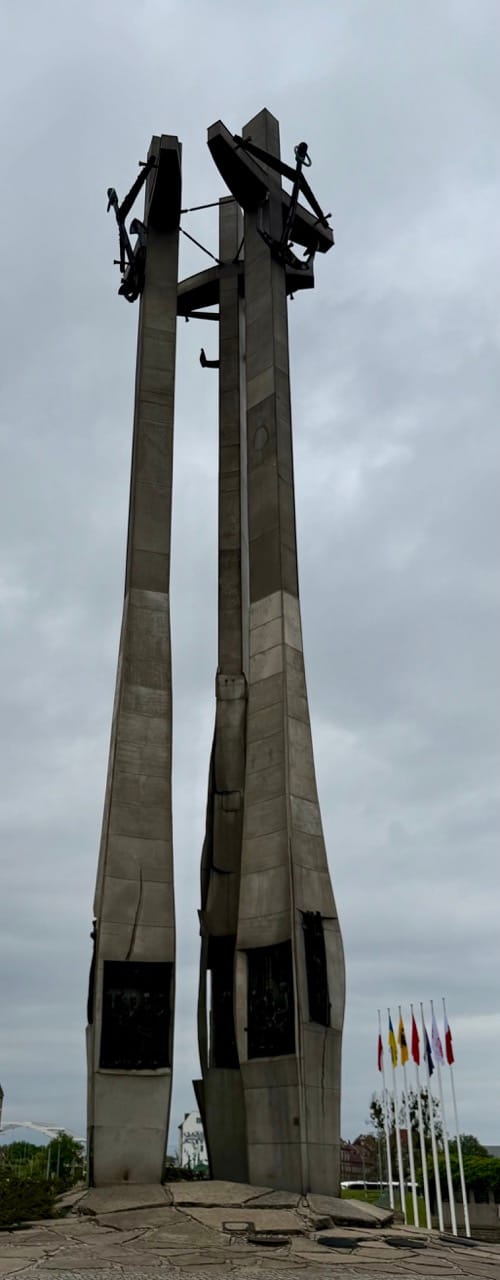
Visitors enter the centre through the former Shipyard Gate No. 2, a focal point for Solidarność strikes. Nearby is the towering “Monument to the fallen Shipyard Workers 1970.” Erected in 1980, it is said to be the first memorial to victims of communist oppression in a Soviet bloc country.
While trade unions in western democracies are independent and represent workers to management, unions under dictatorships, rightwing or left, are state-controlled puppet organizations.
“Walesa mobilized the workers into a labor movement which became the first successful challenge to Soviet authority and control in eastern Europe,” Londrigan said. “But the impact was global.”
Londrigan isn’t sure how Hammond came by the banner. But it may have crossed the Atlantic after Hammond and some other Louisville building trades union leaders sent a letter to Walesa, accusing Bellarmine College, now Bellarmine University, of hiring non-union contractors on campus construction projects.
In April 1990, Bellarmine had given Walesa the Bellarmine Award, which honors individuals who “exemplify charity, justice, and temperateness in dealing with controversy,” according to the May 26, 1990 Louisville Courier-Journal.
Bellarmine is a private Catholic university in Louisville. Walesa is a Catholic as are most Poles. Strong backing by Pope John Paul II, a Polish native, and the Polish Catholic church helped ensure Solidarity’s success.
Support for the right of workers to organize and bargain collectively has long been part of Catholic social teaching. “No one may deny the right to organize without attacking human dignity itself,” said a 1986 statement from the U.S. Conference of Catholic Bishops. “Therefore, we firmly oppose organized efforts, such as those regrettably now seen in this country, to break existing unions and prevent workers from organizing,”
Hammond didn’t pull punches in the Louisville Courier-Journal story about the letter. “We view the Bellarmine Award [to Walesa] as rank hypocrisy,” he said, adding that while “Bellarmine recognized the rights of Polish workers … at home, college officials haven’t ‘practiced what they pretended to preach.’”
Bellarmine denied it favored non-union contractors that employed low-wage workers.
The union leaders were unconvinced. In its May 23 letter, the council congratulated Walesa for receiving the award, but told him “the college ‘shuns the American Labor Movement’ by awarding multi-million dollar construction contracts to firms that ‘exploit their workers’ by paying substandard wages and refusing to provide health insurance. Bellarmine refuses to use union construction contractors. A wrong to working men and women by Bellarmine College is no different than a wrong to the working men and women in the shipyards of Gdansk.”
The letter concluded with “Solidarity forever” and bore the signatures of “17 representatives of Kentucky building trades unions, including carpenters, sheet metal workers, pipefitters, plumbers and electricians,” according to the paper.
It seems possible, or even likely, that Walesa sent Hammond the Solidarity banner after he received the letter. At any rate, Londrigan treasures the banner as a “symbol of worldwide trade union solidarity.”
--30--
Comments