


FRANKFORT — Chante Burg already didn’t have a lot of faith in the medical system when she got pregnant in 2024.
Her two grandmothers both died in childbirth, and the Louisville woman knew that Black women like her are more at risk of maternal health complications.
“I feel that generally, Black women are not heard, and even when we know that something is impacting our bodies, we have to go through more hoops and loops to finally be heard and seen,” Burg told the Lantern.
She would later suffer in pain for 14 hours before undergoing surgery to remove her ectopic pregnancy. An ectopic pregnancy is the result of a fertilized egg implanting somewhere outside the uterus, making a successful pregnancy impossible, according to the Cleveland Clinic.
Burg was in Frankfort Thursday alongside medical providers, academics and faith leaders as Kentucky Physicians for Reproductive Freedom for the third year in a row petitioned the Republican-controlled legislature to repeal Kentucky’s abortion ban. This is unlikely to happen in a state where the General Assembly’s Republican supermajority solidly rejected proposals to add rape and incest exceptions to the abortion ban, even after Kentucky voters in 2022 rejected adding an anti-abortion amendment to the state Constitution.
In addition to rallying in Frankfort, more than 600 medical providers signed a letter asking the legislature to roll back abortion restrictions. Many said state law restricts their ability to care for patients and puts them in “moral distress.”
“Their constituents need to hear directly from patients,” Burg told the Lantern. “I feel like there (are) a lot of religious beliefs and political agendas that are being thrown out there, but they are not listening to the actual women that are impacted by these laws.”
In 2025, the General Assembly passed a law aimed at clearing up confusion around the abortion ban by adding exceptions for miscarriage management, molar and ectopic pregnancy removal, and more.
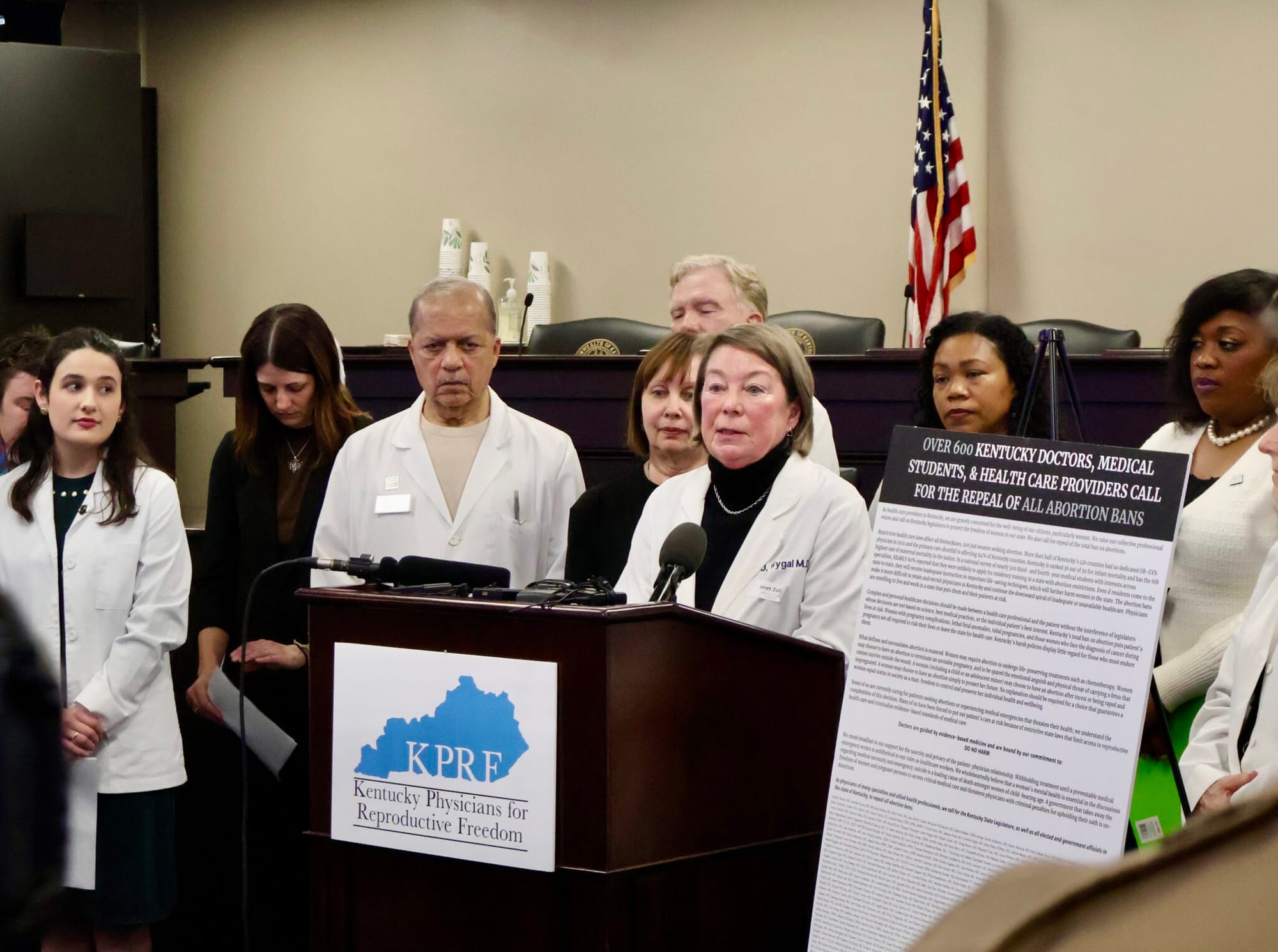
Dr. Janet Wygal, a retired OB-GYN, said Thursday that “nothing changed” after that law passed “without input from the broader medical community.”
“It only created more confusion and felony threats remain, and this reinforces the chilling effects providers continue to experience,” she said. “Care is delayed until a woman’s life is in danger. The language mischaracterizes abortion and assigns personhood to the fetus. It does nothing positive for women’s health.”
‘Has she lost enough blood?’
Dr. Alecia Fields, a Kentucky OB-GYN, said that the abortion law has “fundamentally changed my ability to practice medicine and to care for my patients.”
“It is a moral challenge to practice medicine in a state where physicians are held to a different standard of care than our colleagues in other states,” Fields said. “We are trained to first do no harm. Now we are expected to practice a version of medicine written by politicians, not grounded in evidence or clinical reality.”
“Right now when I am caring for a patient whose water is broken at 15 weeks, when I’m counseling a patient whose baby has just been diagnosed with a fatal fetal anomaly, when I am urgently called to the bedside of a patient bleeding heavily during a miscarriage, my first instinct as a physician has always been the same: ‘What do I need to do to provide the best possible care for this patient?’” Fields said. “Now, a second question enters my mind, one that should never be there: ‘What am I legally allowed to do?’”
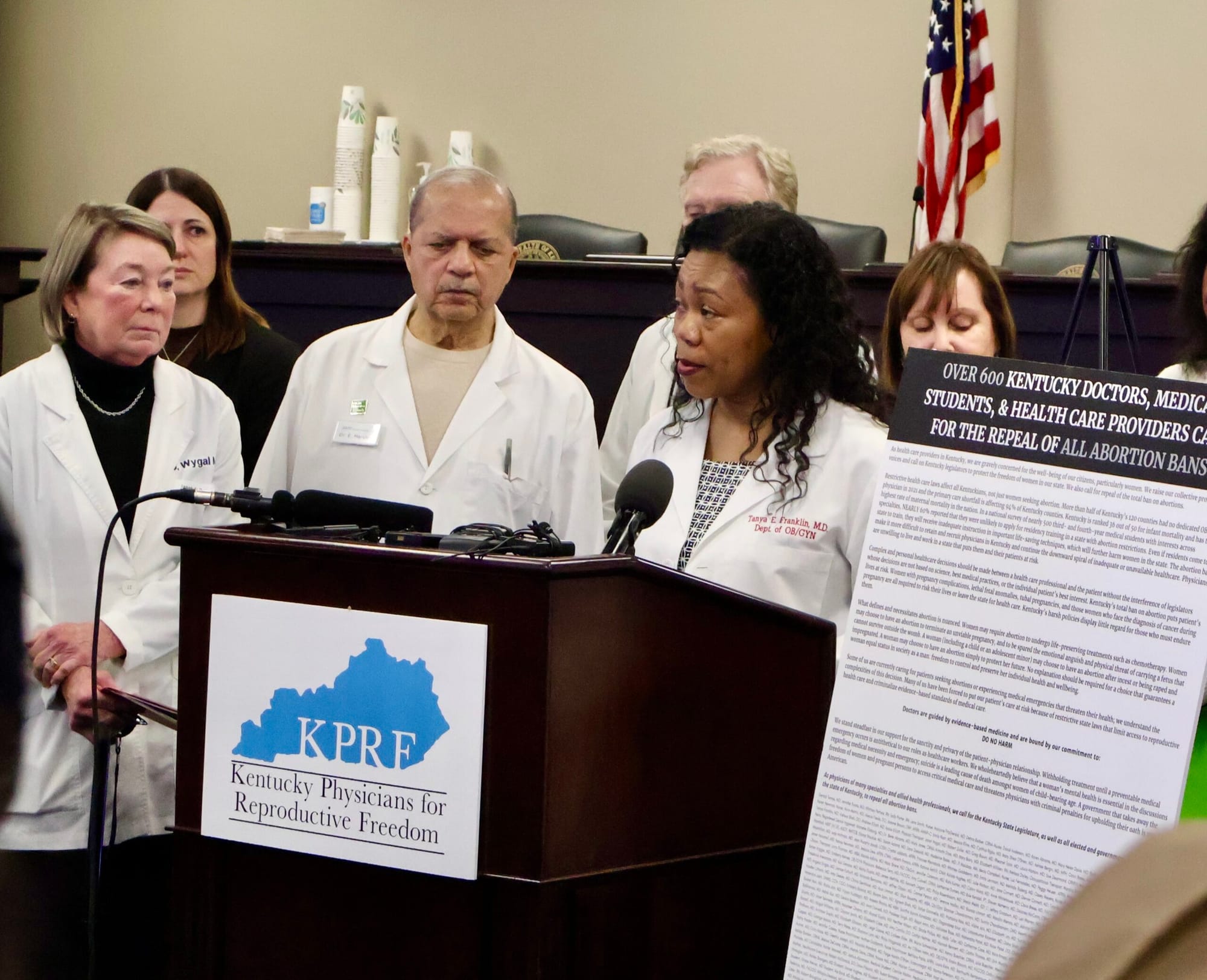
Dr. Tanya Franklin, another OB-GYN, echoed these concerns.
Doctors, Franklin said, are being forced to make “legal assessments when they should be making health care decisions,” she said.
“This is morally distressing. I did not go to law school. I went to college for four years. I went to medical school for four years, and then I completed an obstetrics and gynecology residency in four years,” Franklin said. “We are not experts of the law. We are experts in women’s health.”
“Instead of talking with patients about their diagnosis, their clinical status and their full range of medical options, the conversation becomes, ‘is she sick enough yet for me to intervene?’” Fields said. “Instead of informed consent and thoughtful discussions of risks, benefits and alternatives, the question becomes, ‘has she lost enough blood for this to be considered life threatening?’ Instead of practicing evidence based compassionate medicine, we are forced to filter patient care through lawyers, hospital administrators and politicians.”
‘Where is the fight for our right to life?’
Burg had been pregnant in 2024 for about two months when her symptoms started and she realized something was very wrong. By that point, she and her now-husband were “excited” to have a baby and already picked out a name.
Then she developed numbness in her legs, general malaise, a fever, and a “throbbing in my womb,” she said. She went to urgent care around 2 a.m. Within 14 hours, she had emergency surgery, but while she waited in an emergency room bed, she said, she got nothing for her pain.
“I had to wait until blood pressure numbers dropped until I was kneeling on the brink of death before they finally rushed me into emergency surgery,” she said.
During those 14 hours, “I had to relentlessly self advocate through excruciating pain and fear just to be heard,” she said. “Even in the scariest moment of my life, I carried the burden of not feeling seen, heard or protected.”
The ordeal still impacts her mental health, she said: “I have not been the same since that day.” Her current advocacy and mental health treatment help, she said, and empower her.
She was told after the surgery, she said, that the delay she suffered was because of the murkiness of state law.
“This is a direct contradiction to those claiming to fight for a right to life, because my life and other women’s lives were nearly lost,” Burg said during the press conference. “Considering the fact that Black women face a three to four times higher risk of maternal death than other races: Where is the fight for our right to life?”
--30--
Written by Sarah Ladd. Cross-posted from the Kentucky Lantern.
Comments