

There’s a new doctrine emerging from the Trump administration, and it deserves a name. Let’s call it “Simultaneous Victory and Escalation.”
Under this doctrine, a war can be declared over — terminated, finished, wrapped up — while also being very much ongoing, deteriorating, and potentially about to intensify. It’s a flexible system.
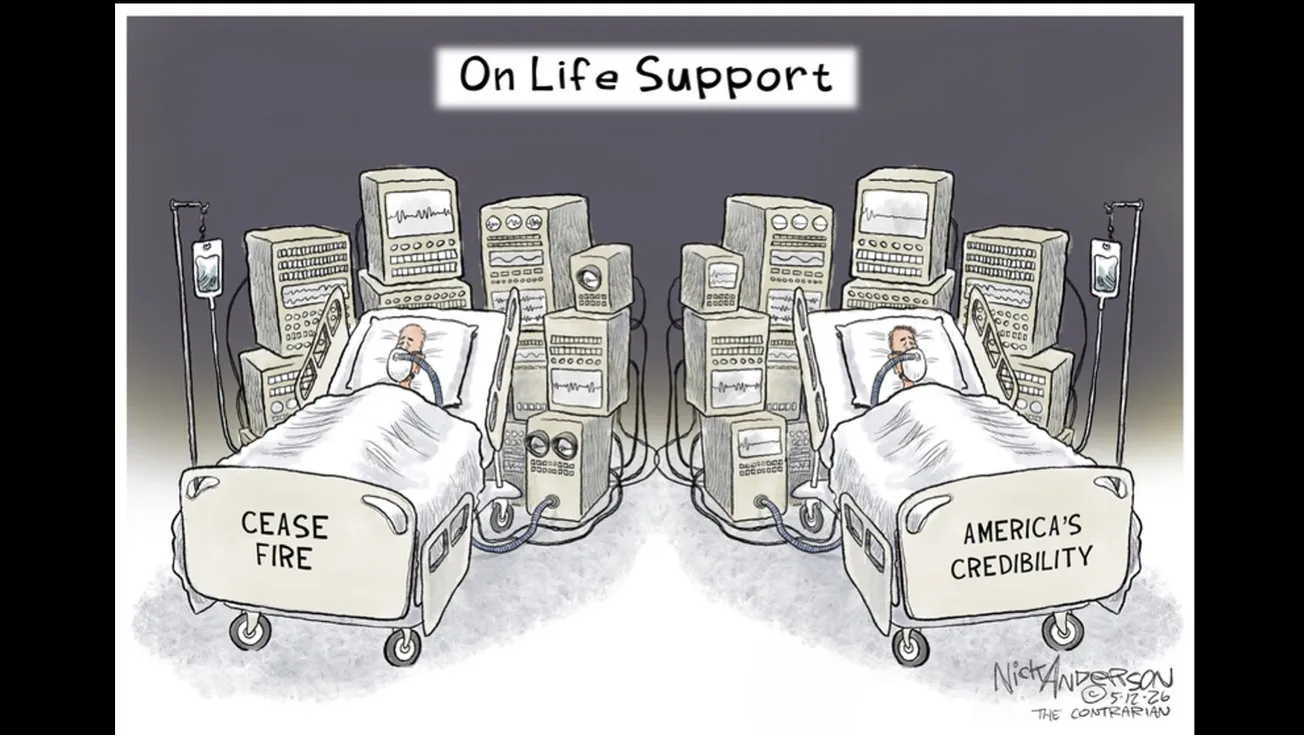
Take the current situation with Iran. On the one hand, we’re told the conflict is effectively resolved. On the other, the president now describes the ceasefire as being on “massive life support,” the geopolitical equivalent of a patient with a 1% chance of survival.
So: over. But barely alive. Possibly dying. And maybe about to require further intervention. Clear enough. And then there’s the matter of strategy, if that’s still the word we’re using.
First came the grand plan: escort ships through the Strait of Hormuz, restore order, project strength. A bold initiative with an even bolder name: Project Freedom. It lasted just long enough to become a punchline. Launched with fanfare, it was called off after roughly two days – paused, we’re told, to allow time for negotiations.
Two days. That’s not a strategy. That’s a soft opening. It’s the foreign policy equivalent of announcing a blockbuster tour, performing one show, and then canceling the rest because you’re “exploring new creative directions.”
Meanwhile, the problem it was meant to solve — the blockade of the Strait of Hormuz — remains very much in place. Tankers are still stranded. Oil prices are still climbing. Roughly 1,500 vessels and 20,000 seafarers are caught in the middle of this geopolitical improv exercise.
But don’t worry – the war is over. Except it isn’t. Because even as the administration talks about peace, it’s also reconsidering military options, floating the possibility of renewed naval escorts, and dismissing diplomatic proposals out of hand.
It’s less a coherent policy than a series of overlapping impulses:
- Declare victory
- Reject compromise
- Pause the plan
- Threaten escalation
- Repeat
At any given moment, you can find evidence for all of these happening at once, and that’s the real problem. Not just the contradictions, but the accumulation of them.
Allies are left guessing, our credibility in worse shape than Iran’s nuclear program. Markets are left reacting. Adversaries are left probing for leverage. And the public is left trying to figure out whether we’re in a war, out of a war, or merely adjacent to one. The answer, apparently, is yes.
There’s a kind of accidental honesty in all of this. Because stripped of the rhetoric, what you’re seeing isn’t a grand strategy. It’s a reactive one. A policy shaped less by long-term planning than by immediate pressures, shifting narratives, and the need to declare success before it actually exists.
Which brings us back to that phrase: “life support.” It’s an apt metaphor, but maybe not for the ceasefire. Because at some point, you have to ask whether it’s the strategy itself that’s being kept alive, propped up by announcements, sustained by contradictions, and functioning just well enough to avoid being declared what it increasingly looks like: Unstable. Unsustainable. And not nearly as “over” as advertised.
--30--
Comments