

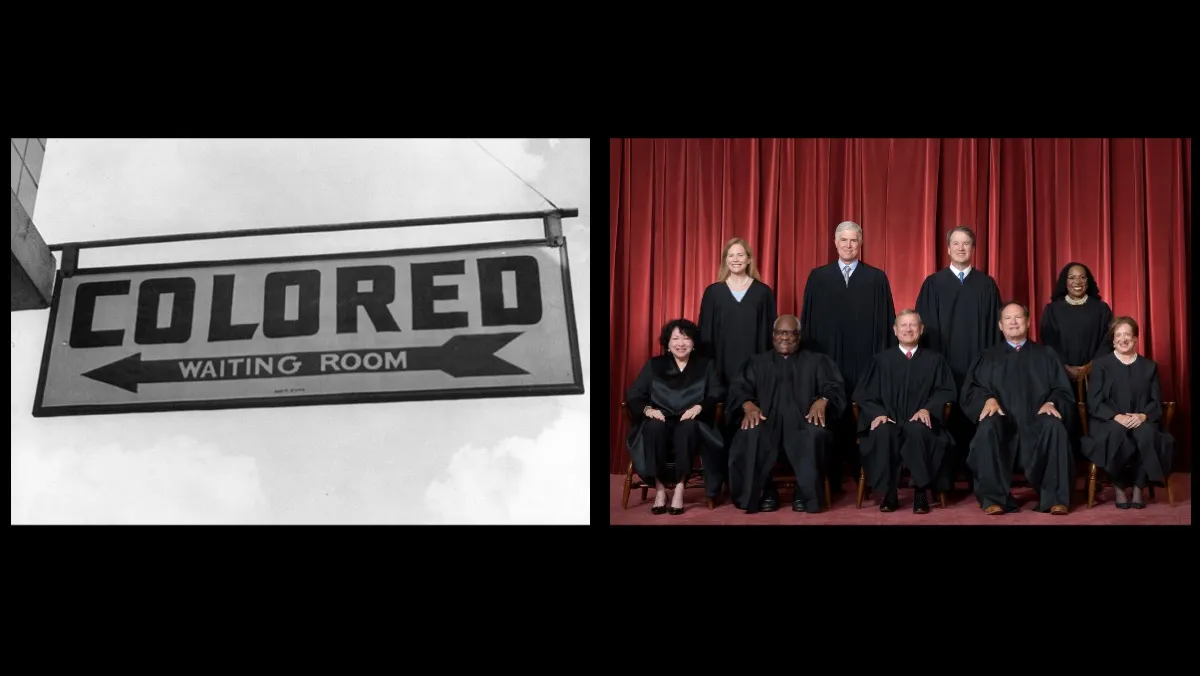
Wednesday’s Supreme Court ruling in Louisiana v Callais “has left the Voting Rights Act of 1965 on life support if not dead,” according to Dr. Brian Clardy, a Murray State University historian.
The high court’s six-member conservative majority overturned Louisiana’s congressional district map and gutted the landmark legislation’s Section 2. The decision “opens the door for states to enact discriminatory maps with impunity,” said an American Civil Liberties Union news release. “As a result, Black voters and other voters of color could face the elimination of districts across the country that have provided fair representation.”
Clardy, a professor who earned a PhD in history at Southern Illinois University-Carbondale, said he wasn’t surprised at the 6-3 decision. “Not in the slightest. I knew when Shelby v.Holder was decided, this was not going to be the end of it.”
According to the ACLU release, “Section 2 has long served as the primary nationwide protection against discriminatory voting systems following the Supreme Court’s 2013 decision in Shelby County v. Holder, which eliminated the Act’s preclearance system.” The release warned, “While today’s decision sharply limits federal voting rights protections, advocacy and enforcement efforts will continue through legislative action, state constitutional claims, and other available legal avenues.”
Republican presidents nominated all six justices who struck down the Louisiana map. Democrats nominated the three dissenters.
Republicans are cheering the Supreme Court ruling, hoping it will boost their chances to hold the House in the midterm elections. Reportedly, Louisiana Republicans are now mulling whether to cancel or postpone the state’s May 16 primary elections to give them time to redraw the congressional district map before November’s midterm elections.
Democrats, progressives, and civil rights organizations are denouncing the decision, arguing that it will allow white Republican state legislatures to gerrymander out most, if not all, Black members of Congress in the old Confederate states.
Clardy likened Louisiana v Callais to Plessy v. Ferguson, aso a Louisiana case. The 1896 ruling paved the way for white supremacist Democratic Southern state legislatures to pass more laws segregating Blacks and denying them the vote.
“The Supreme Court just gave Republican legislatures permission to strip voting power from African Americans, Hispanic Americans, and other communities of color,” said a statement from Colmon Elridge, Kentucky Democratic Party chair. “For years, the GOP has been trying to rig congressional maps and suppress voters’ voices in order to give themselves even more power. With today’s SCOTUS decision, they can continue that quest to disenfranchise Americans legally.
“Racial gerrymandering has no place in a democracy. Kentucky Democrats are committed to defending the right of every American citizen to be heard, and to vote.”
In a statement, NAACP President and CEO Derrick Johnson said the Supreme Court decision “is a devastating blow to what remains of the Voting Rights Act, and a license for corrupt politicians who want to rig the system by silencing entire communities. The Supreme Court betrayed Black voters, they betrayed America, and they betrayed our democracy. This ruling is a major setback for our nation and threatens to erode the hard-won victories we’ve fought, bled, and died for. But the people still can fight back. Our best defense and offense is the ballot box, and we’re going to turn out voters for the midterm elections to make sure we can elect representatives who look out for us. Our democracy is crying for help.”
Added Kristen Clarke, NAACP General Counsel: ““This is one of the most-consequential and devastating rulings issued by the Supreme Court in the 21st Century. The Supreme Court has put the death knell into our nation’s most important federal civil rights law, one that provided Black Americans access to a democracy that they had long been excluded from. The ruling defies precedent, ignores statutory text, and will reverse decades of progress we have made as a nation. This will embolden lawmakers in former slave-holding states to target and eradicate districts that have provided Black Americans a fair opportunity to elect candidates of choice, and they will do so with the blessing of this Court. It ignores the tremendous sacrifice made by Americans who bled and died for passage of the Voting Rights Act.
“Expect more Americans to call into question the integrity and independence of this Court which is moving unabashedly and at lightning speed to dismantle our bedrock civil rights protections.
“The NAACP will not stand by idly in the face of this ruling which seeks to diminish our standing and render us second-class citizens. This is not a moment for any one of us to sit on the sidelines. We are witnessing the full machinery of government aided by the Court disenfranchising and silencing Black America and hijacking democracy as we know it. We will continue to fight and ensure that our voices are heard this midterm election cycle.”
Congressman Morgan McGarvey (D-Louisville) said in a statement, “This Supreme Court decision is a generational setback for American democracy – one that threatens to drag us back to a dark time in our nation’s history. Not since Jim Crow have we seen this level of systemic disenfranchisement of Black voters.
“It’s despicable, and we will not sit back and allow the Court to further erode the hard-fought right to fair representation for Black Americans.
“Congress must pass the John Lewis Voting Rights Advancement Act to undo this harm and prevent future attempts to silence Black voters.”
In a statement, Kentucky Gov. Andy Beshear, Democratic Governors Association chair, denounced the Supreme Court ruling as “a historic blow to the Voting Rights Act and will prevent millions of Americans — especially Black Americans who worked and sacrificed for this landmark law — from having fair representation.
“One of the best ways to fight back is to elect more Democratic governors, who are on the frontline of protecting and expanding fundamental freedoms and democracy in our states. We have 36 opportunities to do that year, and rulings like this show that the stakes have never been higher.”
Clardy said the court decision, like Republican opposition to federal civil rights action across the board, is rooted “in fear of demographic change – this country is growing browner and blacker, and when it comes full circle in 20, 30, or 40 years from now, the power dynamic of this country and globally is going to change. The Republican Party has become the party of Jefferson Davis, Theo Bilbo, George Wallace, and Donald Trump.”
--30--
Comments