

Sixty years ago this week, Congress passed the Voting Rights Act of 1965.
The vote was bipartisan. In the Senate, the tally was 77-19. Thirty Republicans, including Kentucky’s John Sherman Cooper and Thruston Morton, joined 47 Democrats in approving the VRA.
In the House, the VRA passed 333-85, with 112 Republicans and 221 Democrats voting “aye.” The Bluegrass State’s half-dozen Democrats and one Republican — Tim Lee Carter — supported the VRA.
“Civil rights used to be a bipartisan issue, but not anymore,” said Murray State University historian Brian Clardy, a liberal Democratic activist who grew up a conservative Republican in northwest Tennessee.
Founded in the free state North in the 1850s as an anti-slavery party, the GOP has long since abandoned its historic commitment to civil rights. The Democrats are what the Republicans were for more than a century, and the Republicans are now largely the party of conservative whites.
“The Republican party is no longer the party of Lincoln,” said Clardy. “It looks more like the party of George Wallace. There are no moderate or liberal Republicans like there were in the past.”
He cited Cooper among the moderates and liberals.
Shelby County v Holder
In 2013, the Court gutted the Voting Rights Act in Shelby County v Holder. The vote was 5-4; Republican presidents nominated all 5 justices in the majority. Now the court has a 6-3 rightwing majority, all 6 appointed by GOP presidents, half by Donald Trump. The majority seems poised to take up a Louisiana redistricting case and possibly issue a ruling that would weaken the VRA even more.
The John R. Lewis Voting Rights Advancement Act
In 2021, House Democrats united behind the John R. Lewis Voting Rights Advancement Act, naming the legislation for the late Georgia congressman and civil rights icon. The bill was designed to restore the VRA to its original intent: to safeguard the voting rights of citizens of color.
The measure passed the Democratic-majority House, 219-212. No Republican voted for the bill.
As the historic anniversary of the VRA approached, Sen Ralph Warnock and other Senate Democrats reintroduced the Lewis Act. But the bill has almost no chance to pass in the Republican-majority House and Senate.
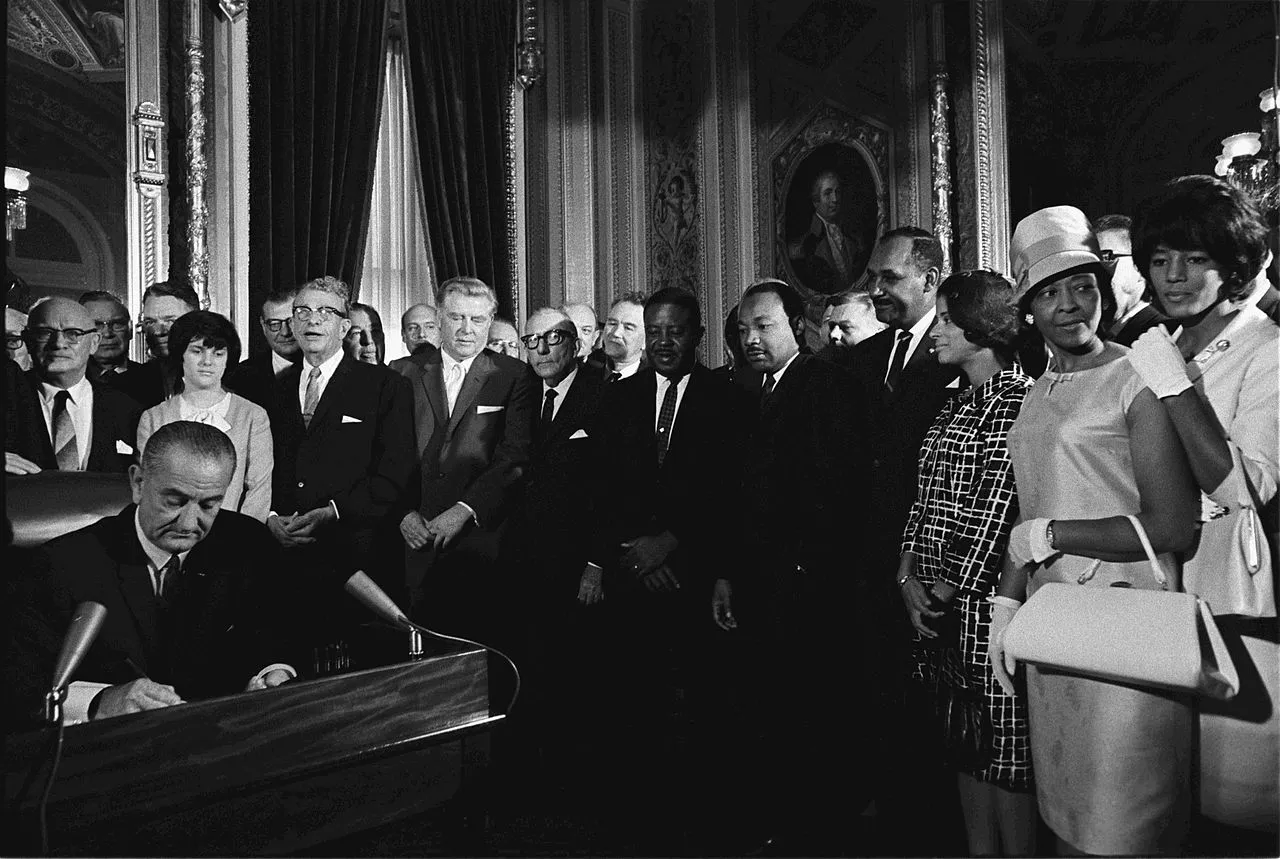
President Lyndon B. Johnson, a Texas Democrat, championed the Voting Rights Act and other civil rights bills that were hailed as a “Second Reconstruction.”
Johnson signed the VRA on Aug. 6, 1965. “This has been an historic week for the extension of democracy in this country,” the Louisville Courier-Journal editorialized on Aug. 7. “… Democracy advances irregularly, with many twists and turns, and the American dream sometimes seems to turn into a nightmare. But the dream does not die. A century after the Civil War, the President and Congress finally seal a promise that came out of that bloody conflict, touching the mystic chord of memory that Lincoln spoke of in his vision of the Republic.”
The Republican retreat on civil rights
Clardy laments what he calls his former party’s long retreat on civil rights. He said the flight began in the 1960s and 70s with President Richard Nixon’s “Southern Strategy” and accelerated with Ronald Reagan’s presidency.
Clardy said it was no coincidence that Reagan opened his 1980 presidential campaign in Philadelphia, Miss., seat of Neshoba County. The historian recalled that 16 years before, members of the Ku Klux Klan kidnapped and murdered three civil rights workers and buried their bodies in an earthen dam in rural Neshoba County.
Reagan told the cheering white crowd he was for “states’ rights,” the term Southern white supremacist Democrats used to justify slavery before the Civil War and Jim Crow segregation and Black disenfranchisement afterwards.
“‘States’ rights’ wasn’t a dog whistle,” Clardy said. “It was a bullhorn.”
He said Donald Trump has outdone Reagan in race-baiting. Trump, he added, ran the three most overtly racist presidential campaigns since former Alabama Gov. George Wallace, an erstwhile white supremacist Democrat, ran for president in 1968 on the segregationist American Independent Party ticket.
Writing in The Nation after the House Republicans bloc voted against the Lewis Act in 2021, John Nichols denounced the GOP for uniting “in grotesquely self-serving and destructive opposition to principles it historically championed.”
Added Nichols: “In the 1950s, Republican President Dwight Eisenhower worked to earn Black votes – with the support of Democrats who crossed party lines to support him, including New York Representative Adam Clayton Powell and [former] Vice President Henry Wallace. In the face of Democratic filibusters, Ike advocated for congressional action on the groundbreaking Civil Rights Acts of 1957 and 1960, appealing to supporters of the burgeoning civil rights movement of the era.”
He quoted from the 1960 Republican platform: “This nation was created to give expression, validity and purpose to our spiritual heritage – the supreme worth of the individual. In such a nation — a nation dedicated to the proposition that all men are created equal — racial discrimination has no place. It can hardly be reconciled with a Constitution that guarantees equal protection under law to all persons. In a deeper sense, too, it is immoral and unjust. As to those matters within reach of political action and leadership, we pledge ourselves unreservedly to its eradication.”
Nichols said GOP leaders in Congress (including Cooper) “provided advice, counsel, and support that was essential to the development and passage of the Civil Rights Act of 1964. While Democrats struggled with their party’s internal contradictions on the issue — deferring far too frequently to the demands of the Southern racists who held powerful committee chairs in the House and Senate, and who commanded machines that delivered needed electoral votes — Republicans demanded action.
“‘When President John F. Kennedy failed to submit a promised civil rights bill, three Republicans [Representatives William McCulloch of Ohio, John Lindsay of New York, and Charles Mathias of Maryland] introduced one of their own,’ noted The New York Times in recalling the great struggles of the era. This inspired Mr. Kennedy to deliver on his promise, and it built Republican support for what became the Civil Rights Act of 1964.’”
While LBJ pushed hard to pass the landmark legislation “Republicans were significantly more supportive ... than were Democrats. The measure passed the House on a 290-130 vote, with support from 61 percent of House Democrats (152 in favor, 96 opposed),” Nichols wrote. “But Republican lawmakers gave it 80 percent backing (138 in support, just 34 against). The critical test came in the Senate in June, 1964. Republicans aligned with Northern Democrats to break the segregationist filibuster. A striking 82 percent of Republican senators endorsed final passage of the measure, as opposed to two-thirds of Senate Democrats.”
Republicans joined Democrats in renewing and strengthening the VRA five times between 1970 and 2006.
“The Republican Party was, for a vital century, the major American political party that most frequently aligned with the cause of civil rights," Nichols also wrote. "The Republicans were far from perfect; they were too slow, too compromising, too weak. But the great realist of the 19th century Frederick Douglass explained in the 1880s, ‘I knew that however bad the Republican Party was, the Democratic Party was much worse. The elements of which the Republican Party was composed gave better ground for the ultimate hope of the success of the colored man’s cause than those of the Democratic Party.’”
Nichols concluded, “The abandonment of the legacy that caused Douglass to write those words is the great tragedy of the modern Republican Party, and of a political process in which one party has evolved from its shameful past while the other has devolved toward a shameless present.”
--30--
Comments