


You won’t be surprised that Donald J. Trump doesn’t know history. After all, this is the president who thought Catholics loved the sacrilege of his portraying himself as pope. So Trump doesn’t understand that his would-be successors aren’t going to wait until he’s dead to try to rule his empire.
As you might have guessed, the reign of Emperor Nero, the sweetheart who murdered his own mother and wife and castrated a boy whom he then married, didn’t end well. Even before Nero had his private secretary kill him because he couldn’t face killing himself, according to Suetonius, the emperor was having some, ahem, issues. Historians Josephus, Pliny the Elder, Cluvius Rufus, Fabius Rusticus, Epictetus, Cassius Dio, Tacitus, and Seneca the Younger all agree that Nero was an incompetent tyrant. (No argument amongst modern scholars.)
Without going into too much detail, let’s just say that three of Nero’s provincial governors fought amongst themselves to get rid of him, eventually leading Gaius Nymphidius Sabinus, the head of the Praetorian Guard (the Roman equivalent of the Secret Service and military intelligence combined) to turn against Nero. Nero, justifiably alarmed, tried to flee Rome, but he was blocked at every turn. Instead, he had someone kill him in June of A.D. 68.
Nero’s death marked the end of the Julio-Claudian dynasty. The Roman Senate declared one of those provincial governors mentioned above, Servius Sulpicius Galba, the new emperor. Now Galba was no Trump, which is to say he wasn’t an idiot. He immediately murdered several of his opponents and fired others. But Galba, like Trump, stiffed a number of people he’d made promises to. Also like Trump, Galba was surrounded by sycophants and put incredibly incompetent men, selected based on loyalty, in the highest posts. (We’d call them #MAGAhires these days.) One of these was an incompetent glutton named Aulus Vitellius, who was made the governor of Germania Inferior (modern-day southern Netherlands, Luxemburg, Belgium, and the state of North Rhine-Westphalia in Germany). (We’ll be hearing more about Vitellius later.) Those who Galba stiffed held grudges, and Galba was killed by the Praetorian Guard in January of A.D. 69.
The Senate voted in a new emperor, Marcus Salvius Otho, the Lusitanian governor and someone both Nero and Galba had crossed. This didn’t last long. Remember that incompetent, Aulus Vitellius? Well, he declared himself emperor (no need for that pesky Senate vote!) and sent half his army toward Rome. After a big military defeat, Emperor Otho committed suicide. His reign had lasted just over three months.
Better late than never, the Roman Senate got on board with what was a foregone conclusion: the Senate confirmed Vitellius as emperor. What choice did they have? Vitellius had been put in charge of the finest legions in the Roman Empire.
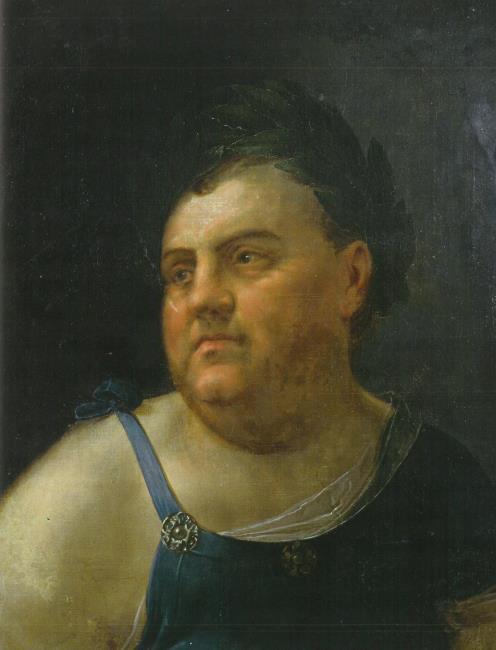
But Vitellius, pictured here so readers can appreciate the resemblance of Vitellius double chin and bad hair to Trump’s (photo from Wikipedia Commons), was also just as stupid as Trump. He spent his time honoring himself at banquets, sometimes three in one day, according to Suetonius, and triumphal parades. Vitellius spent so much money lauding himself that he was draining the Roman treasury. A cruel man, he ordered the torture and execution of anyone who he borrowed money from that insisted on payment. That’s in addition to murdering any supposed rivals, and even common citizens who were too much of a pest.
The Roman legions had had enough. Those in Egypt and the Middle East picked their own new emperor, Titus Flavius Vespasianus (commonly known as Vespasian), a very successful and clever general with many friends in high places and a son Titus, himself a clever, successful general. Vespasian’s armies entered Italy, defeated Vitellius’ army and entered Rome. The Capitol was burnt to the ground, and with it Vitellius. The Senate declared Vespasian emperor in December of A.D. 69.
Unlike Vitellius (or Trump), Vespasian was no dummy. He sent much-needed grain to Rome and reversed the unfair laws imposed by Nero. Then he launched building projects to provide jobs and restore buildings to be used by the plebians. The Coliseum in Rome? Thank Vespasian. That’s just one example.
There are three lessons here. First, no one’s waiting for Trump to die to finagle to be the next emperor. Those pathetic press conferences and Twitter beefs from Vice President JD Vance clearly denote his realization that the base hates his eyelinered self, and he’s trying to get the MAGA mob on his side. Stephen Miller, who’s clearly running the White House already, surely sees himself as the obvious successor. Ted Cruz, Josh Hawley, Marjorie Taylor Greene, Ron DeSantis, and more think they should be next MAGA monarch. (You can read Axios’ 2028 GOP horserace story here, The Hill’s here, Politico’s here, The Associated Press’ here, The New York Post’s here, Real Clear Polling’s here, and Race to the White House’s here. Here‘s what the betting markets were saying in July.)
The second lesson is that throwing banquets for yourself in a $300 million ballroom à la Vitellius isn’t the best way to get the plebians to like you. Especially when your economic decisions are making their lives worse. Nor is taking enormous and cartoonishly gold-plated gifts and then giving those donors (and countries) whatever they want. (See Nero.) Or having your brutal stormtroopers brutally attack people. (Again, see Vitellius.) And elevating incompetent #MAGAhires to hire office won’t protect you. (See Galba.)
Lastly, in the end, the Army is who decides how much you can get away with. Last time I checked, they didn’t clap.
--30--
Comments



