

“There are obvious echoes between Louisiana v. Callais, in which Justice Samuel Alito’s majority opinion finished off the [1965 Voting Rights Act] … and the notorious Plessy v. Ferguson decision, in which the court blessed Jim Crow,” Pema Levy wrote in Mother Jones magazine on May 7.
“The Roberts court is in many respects a neo-Confederate court, and it repeatedly applies the tactics and ideas of the 1880s and 1890s court, whose members likewise could not abide a robust vision of equality.”
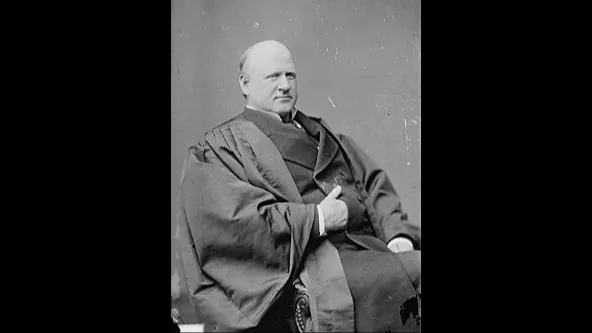
May 18 is the 130th anniversary of the Plessy case, whose sole dissenter was Kentucky native John Marshall Harlan. “Our constitution is colorblind, and neither knows nor tolerates classes among citizens,” he argued, adding that racial segregation “cannot be justified upon any legal grounds.”
His “dissent in the Plessy case is memorable, first, for the courage he displayed,” said James Klotter, author and Kentucky state historian. “Alone of the justices, he spoke for the future, for ‘the better angels of our nature,’ and for the rights of mankind.”
Harlan seemed an unlikely champion of Black rights. He was born into a wealthy slaveholding family in southern Mercer County – now Boyle County – in 1833. He grew up to own slaves and had been an outspoken defender of the South’s peculiar institution.
Historians agree
Murray State University historians Brian Clardy and William Mulligan also see alarming parallels between Callais and Plessy.
“Both decisions represent conservatism that privileges hate and white supremacy, Plessy after Reconstruction, Callais after landmark civil rights legislation in the 1960s that was called a second Reconstruction,” said Clardy, a professor of history.
“The Callais decision continues a troubling trend – reversing decisions that have expanded the definition of who receives full rights and equal treatment,” said Mulligan, a history professor emeritus. He proposed that the court’s six-member conservative majority might heed Justice Louis D. Brandeis’ argument that “what matters most is the result of a law or a decision.” (The University of Louisville Law School is named for Brandeis, a Louisville native.)
Added Levy: “Harlan’s canonical dissent in Plessy could, in many parts, apply to Callais too. In his view, a law doesn’t fulfill the Constitution’s obligations to equality if its effects are discriminatory.”
She wrote that the majority used Harlan’s claim that the constitution is “color-blind” to justify its ruling. “Harlan, of course, was not arguing for a context-blind, effects-blind reading of the Constitution. … Look around, Harlan urged. But the majority, then and today, refuse to.”
An unlikely dissenter
Named for John Marshall, the renowned early 19th century chief justice, Harlan chose a career in law. He was pro-slavery and pro-Union, like most Kentuckians. The state’s pro-Confederate minority said only secession could save slavery.
Harlan fought as a Union army colonel in the early part of the Civil War. After his father died in 1863, Harlan resigned his commission and came home. Soon afterwards, he was elected attorney general on the conservative Union Democratic ticket.
He and his party vigorously opposed the Emancipation Proclamation, though it did not apply to Kentucky. In the 1864 presidential contest, Harlan voted for Union Gen. George McClellan over President Abraham Lincoln, whom he had also rejected in the 1860 election.
After the war ended in 1865, Kentucky became intensely pro-Southern, and Harlan was defeated for reelection in 1867. White supremacist Democrats, many of them former Confederate soldiers and sympathizers, dominated the General Assembly, which refused to ratify the 13th, 14th and 15th Amendments.
After initially opposing the Republican-championed amendments, Harlan, also a former Whig and “Know-Nothing,” stunned fellow conservative Kentuckians by embracing them and joining the GOP he had hated for years. President Rutherford B. Hayes named him to the Supreme Court in 1877.
The Republicans mostly controlled national politics, so Harlan’s critics, Democrats and some Republicans, accused him of political opportunism. Klotter said the charge was false. “But he may have taken his stand, perhaps for personal reasons, for he had a Black half-brother named Robert Harlan.”
Harlan’s brother changed his views
Robert Harlan prospered in business and “became a respected and successful citizen,” Klotter said. “John Marshall Harlan recognized that Robert’s life refuted the notion of Black inferiority … he knew that his half-brother was the equal of all men when it came to business acumen, political leadership, and much more. He could not, in good faith, support a segregated world that denied basic black rights and so he dissented once more in Plessy.”
Harlan was the lone naysayer in other civil rights cases, including an 1883 ruling that overturned the Civil Rights Act of 1875. The measure banned racial discrimination in “accommodations, theatres, public schools, churches, and cemeteries.” The law also prohibited “the barring of any person from jury service on account of race and provided that all lawsuits brought under the new law would be tried in federal, not state, courts.”
In dissenting, Harlan wrote, “Deprived of their enjoyment in common with others, a freeman is not only branded as one inferior and infected, but, in the competitions of life, is robbed of some of the most essential means of existence, and all this solely because they belong to a particular race which the nation has liberated.”
In a letter to Harlan, civil rights leader Frederick Douglass wrote, “I am glad sir, that in this day of compromise and concession where it is so much easier to drift with the current, to sacrifice conviction for the sake of peace, that you have been able to adhere to your convictions and thus save your soul. When self respect is lost the soul is lost.”
Harlan died in 1911 and is buried in Rock Creek Cemetery in Washington, D.C.
Harlan “accurately predicted problems ahead for America if [Plessy] … became the law of the land, for it could not represent the future,” Klotter said. “His courageous words echoed through the years; his lone stance makes his dissent perhaps the most forceful and far-reaching in American history. The ‘Great Dissenter’ fully earned his moniker with the greatest dissent in the history of the court.”
--30--
Cross-posted from the Kentucky Lantern.
Comments