

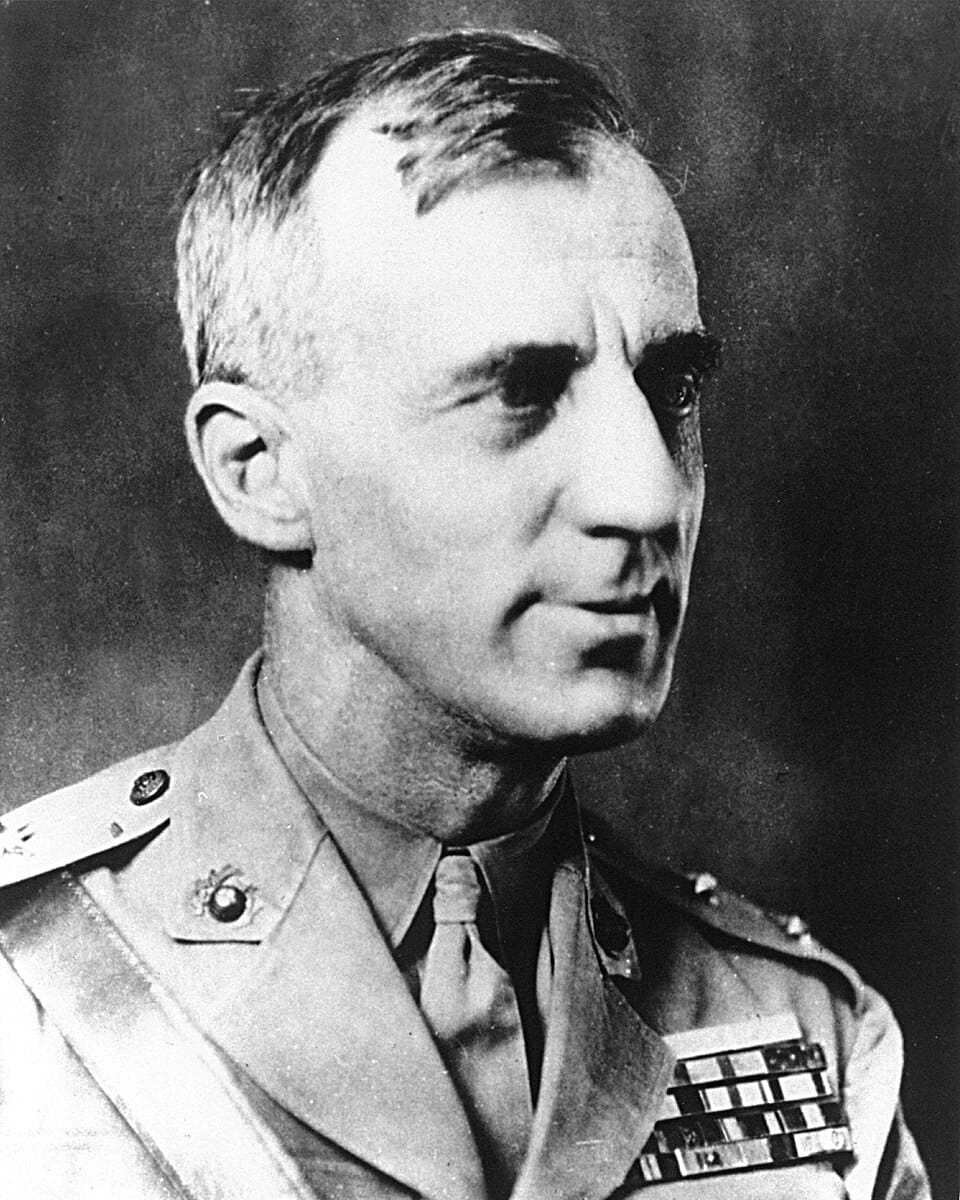
Smedley Butler was a major general in the Marines, and one of the most-decorated Marines of all time. After leaving the military, he became an outspoken critic of American foreign policy and military interventions, which he saw being driven primarily by U.S. business interests.
When I heard President Trump say in his post-coup presser that he was gifting Venezuela’s big oil to U.S. Big Oil, I immediately thought of Butler’s account of how he helped Uncle Sam flex his military muscles on behalf of U.S. big business.
In his book War Is a Racket, the two time Medal of Honor recipient stated:
I spent thirty-three years and four months in active military service as a member of this country’s most agile military force, the Marine Corps. I served in all commissioned ranks from Second Lieutenant to Major-General. And during that period, I spent most of my time being a high class muscle-man for Big Business, for Wall Street and for the Bankers. In short, I was a racketeer, a gangster for capitalism.
I suspected I was just part of a racket at the time. Now I am sure of it. Like all the members of the military profession, I never had a thought of my own until I left the service. My mental faculties remained in suspended animation while I obeyed the orders of higher-ups. This is typical with everyone in the military service.
I helped make Mexico, especially Tampico, safe for American oil interests in 1914. I helped make Haiti and Cuba a decent place for the National City Bank boys to collect revenues in. I helped in the raping of half a dozen Central American republics for the benefits of Wall Street. The record of racketeering is long. I helped purify Nicaragua for the international banking house of Brown Brothers in 1909-1912. I brought light to the Dominican Republic for American sugar interests in 1916. In China I helped to see to it that Standard Oil went its way unmolested.
During those years, I had, as the boys in the back room would say, a swell racket. Looking back on it, I feel that I could have given Al Capone a few hints. The best he could do was to operate his racket in three districts. I operated on three continents.
“In the slightly less than a hundred years from 1898 to 1994, the U.S. government has intervened successfully to change governments in Latin America a total of at least 41 times,” wrote John Coatsworth in ReVista Harvard Review of Latin America. “That amounts to once every 28 months for an entire century. ... Direct intervention occurred in 17 of the 41 cases. These incidents involved the use of U.S. military forces, intelligence agents or local citizens employed by U.S. government agencies. In another 24 cases, the U.S. government played an indirect role. That is, local actors played the principal roles, but either would not have acted or would not have succeeded without encouragement from the U.S. government.”
Trump met the press just hours after he sent in the U.S. military to topple Venezuelan President Nicolás Maduro, capture him, and spirit him stateside to face criminal charges connected to alleged drug trafficking and terrorism. Maduro is a corrupt, murdering thug. But historically, the U.S. has deposed or helped depose freely-elected reformist Central and South American leaders who tried to stop rampant exploitation by U.S. corporations operating in their countries. After the coups, U.S. business-friendly rightwing dictators took over.
“We’re going to have our very large United States oil companies — the biggest anywhere in the world — go in, spend billions of dollars, fix the badly broken infrastructure, the oil infrastructure,” Trump announced to reporters gathered in his Mar-a-Lago mansion. Translation: Help his Big Oil bankrollers make big bucks.
American imperiousness south of the border is rooted in the Monroe Doctrine of 1823 in which “the US unilaterally claimed Latin America as its exclusive sphere of influence,” Eric Ross wrote in Fair Observer last month. “Its revival today is unmistakable and distinctly dangerous. As Secretary of Defense Pete Hegseth declared, echoing the language of that two-century-old policy, ‘The Western Hemisphere is America’s neighborhood, and we will protect it.’” “Protect” is a euphemism for “do as we please in Latin America.”
Added Ross: “The results of that doctrine have long been clear: immense profits for the few – and violence, political upheaval, social dislocation and economic devastation for the many.”
“Our position has been precarious in Latin America for years,” said Dr. Brian Clardy, a Murray State University historian. “We became the overbearing Gringo who supports dictators. Trump has squandered what little political capital we had in Latin America. This will not end well.”
--30--
Comments