

Time Senior Correspondent Philip Elliott wrote that the most jarring line in President Donald Trump’s dissembling diatribe at the World Economic Forum in Switzerland “stood out, as if it were a cutting-room-floor discard from Goodfellas.
He quoted Trump: “We want a piece of ice for world protection, and they won’t give it. You can say yes and we will be very appreciative. Or you can say no and we will remember.”
Added Elliott: “Another way to read that familiar frame? We can do this the easy way or the hard way.”
Trump meant grabbing Greenland, though in his rambling rant he said he won’t use military force to glom the autonomous territory of the Kingdom of Denmark, one of our oldest and most faithful allies in NATO.
After Trump raised the possibility of sending troops to seize Greenland, NATO members Finland, France, Germany, the Netherlands, Norway, Sweden and the United Kingdom sent small military contingents to demonstrate solidarity with Greenlanders and Danish troops on the island and to prove their readiness to increase arctic security.
The symbolic show of force, plus growing stateside opposition to Trump’s Greenland heist, apparently prompted Trump to sheath his imperial sword, at least for now.
Apparently, it’s TACO time again: “Trump Always Chickens Out.”
I get Elliott’s discomfiture at Trump’s mob boss-like boast. But here are the president’s words that most rankled this historian, and I suspect many others: “Then after the war, which we won. We won it big. Without us, right now, you’d all be speaking German and little Japanese perhaps.”
Trump’s take on World War II reminds me of a line in “Wonderful World,” that 60s Sam Cooke classic: “Don’t know much about history.” (“Don’t know much about geography” is another line that applies to Trump. In his speech he seemed to mix up Greenland and Iceland.)
We didn’t win World War II by our lonesome. But don’t just take my word for it.
U.S. Gen. Dwight D. Eisenhower, supreme commander of Allied Expeditionary Forces in Europe — mostly American, British, British Commonwealth and Free French — said of his troops: “You did not pause until our front was firmly joined up with the great Red Army coming from the East, and other Allied Forces, coming from the South. Full victory in Europe has been attained.”
Said British Prime Minister Winston Churchill: “Finally almost the whole world was combined against the evil-doers, who are now prostrate before us. Our gratitude to all our splendid Allies goes forth from all our hearts in this Island and throughout the British Empire.”
Soviet Premier Joseph Stalin praised his British and American allies, especially the latter: “I want to tell you what, from the Russian point of view, the president and the United States have done for victory in this war,” he said. “The most important things in this war are the machines. ... The United States is a country of machines. Without the machines we received through Lend-Lease, we would have lost the war.”
Writing in his memoirs, Nikita Khrushchev, the Soviet premier who risked nuclear war with the U.S. by sending missiles to Cuba in 1962, confessed. “If the United States had not helped us, we would not have won the war. One-on-one against Hitler’s Germany, we would not have withstood its onslaught and would have lost the war. No one talks about this officially, and Stalin never, I think, left any written traces of his opinion, but I can say that he expressed this view several times in conversations with me.”
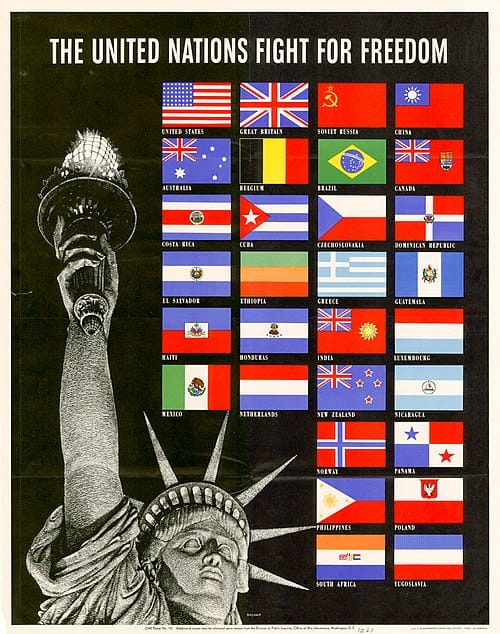
Stalin, Churchill, and U.S. President Franklin D. Roosevelt were dubbed “the Big Three” Allied war leaders.
A ruthless, paranoiac dictator who had millions of Soviet citizens, including loyal communists, murdered or imprisoned, Stalin didn’t trust Churchill and Roosevelt. Likewise, anti-communists Churchill and FDR were wary of Stalin. But all three leaders recognized that defeating the common enemy Hitler was a joint effort.
Churchill and Roosevelt understood that, by far, the largest, most lethal, and most destructive theater of World War II was the Eastern Front. “Stalin broke the back of the Nazi beast,” Churchill said. “The world should be eternally grateful to Stalin for saving it from Hitler,” said Roosevelt.
China, allied with U.S., British, and British Commonwealth forces in the war against imperial Japan, suffered immensely under brutal Japanese occupation. (The Soviets didn’t declare war on Japan until Aug. 8, 1945, two days after the U.S. dropped the first atomic bomb on Japan, which effectively surrendered on Aug. 15, six days after the second bomb was dropped.).
Before World War II ended,
- The Soviet Union suffered 24 million military and civilian deaths
- China, 20 million military and civilian.
- UK, 383,600 military, 67,100 civilian.
- US, 416,500 military, 300 civilian.
It could be argued that the truth about who won World War II was the first casualty in the Cold War. Americans said we won. The Soviets said they won. History instructs that no single nation could have defeated Germany and Japan by itself.
Trump’s claim that “we” won World War II “big” was Cold War propaganda pushed most zealously by reactionaries of the “better dead than Red persuasion.”
Before much of the world prepared to mark the 80th anniversary of the war’s end in Europe on May 8, 2025, Trump, according to a Newsweek story by Emma Marsden, posted on Truth Social, his social media platform, that the U.S. won both World War I and II. “Nobody was close to us in terms of strength, bravery, or military brilliance,” he declared.
Trump’s remarks didn’t go unchallenged, speedily drawing “criticism from many who called the comments dismissive of the sacrifices made by other Allied nations as the United Kingdom, Soviet Union (now Russia), Canada, France and others suffered immense losses and played critical roles across multiple fronts,” Marsden wrote in another Newsweek story. “While historians agree the U.S. was decisive, particularly through industrial support, D-Day, and the Pacific campaign, many emphasize that WWII was won through coordination, shared sacrifice, and a multinational alliance.”
Speaking for many, if not most scholars, British historian Richard Overy, a World War II authority, told Newsweek in a statement, “Trump’s statement is an extraordinary distortion of history, putting him in the same category as Putin, though in Trump’s case he seems to have forgotten entirely what the Red Army achieved in World War II. So we have two world leaders who both think their country won the war. They would benefit from reading more history.
“The claim for World War I is even more of a distortion, as surely everyone will know. The British, French, and Italians defeated the Central Powers, with some U.S. help in the last months. This is history that Trump really ought to read. His claim as it stands is nonsense.”
--30--
Comments