


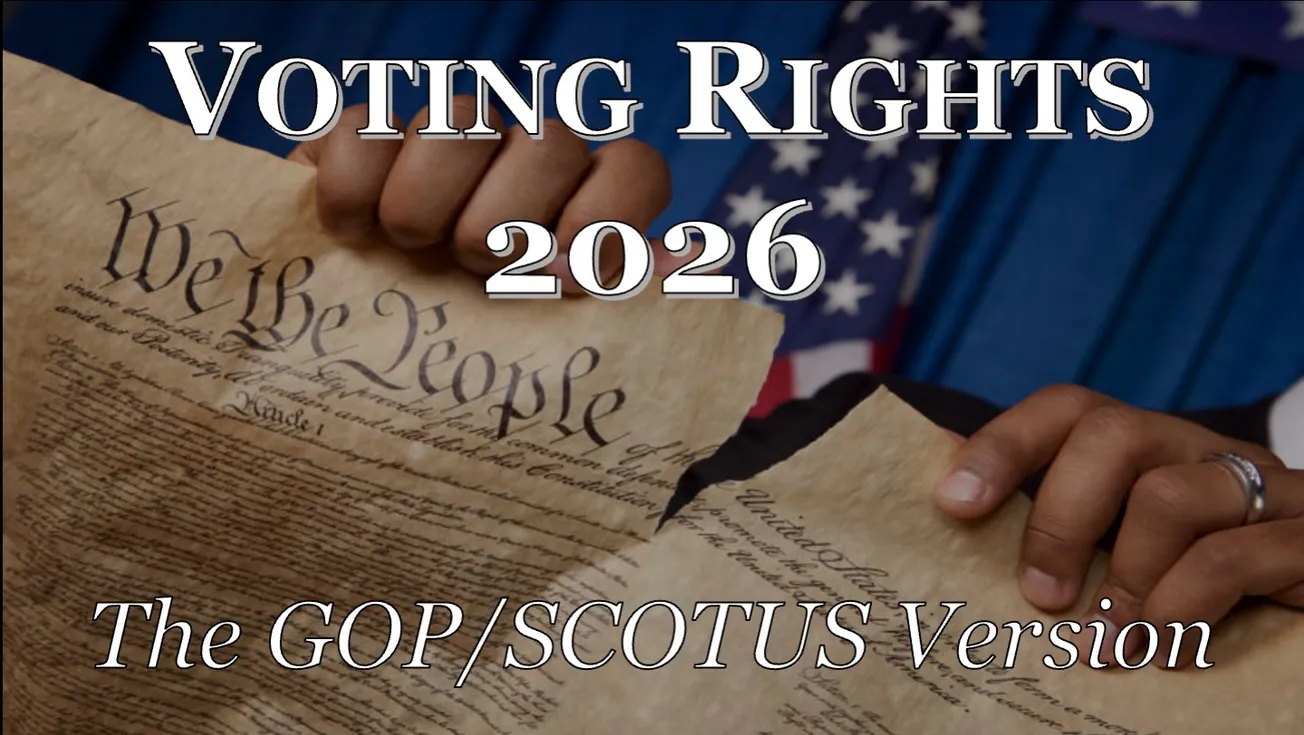
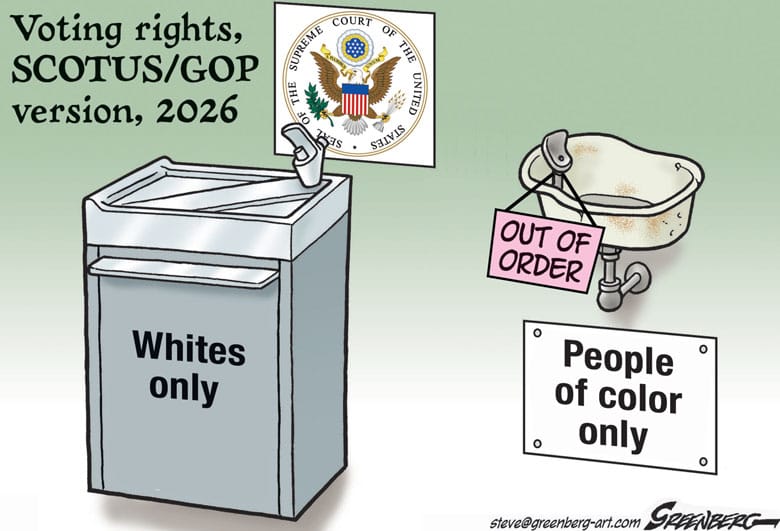
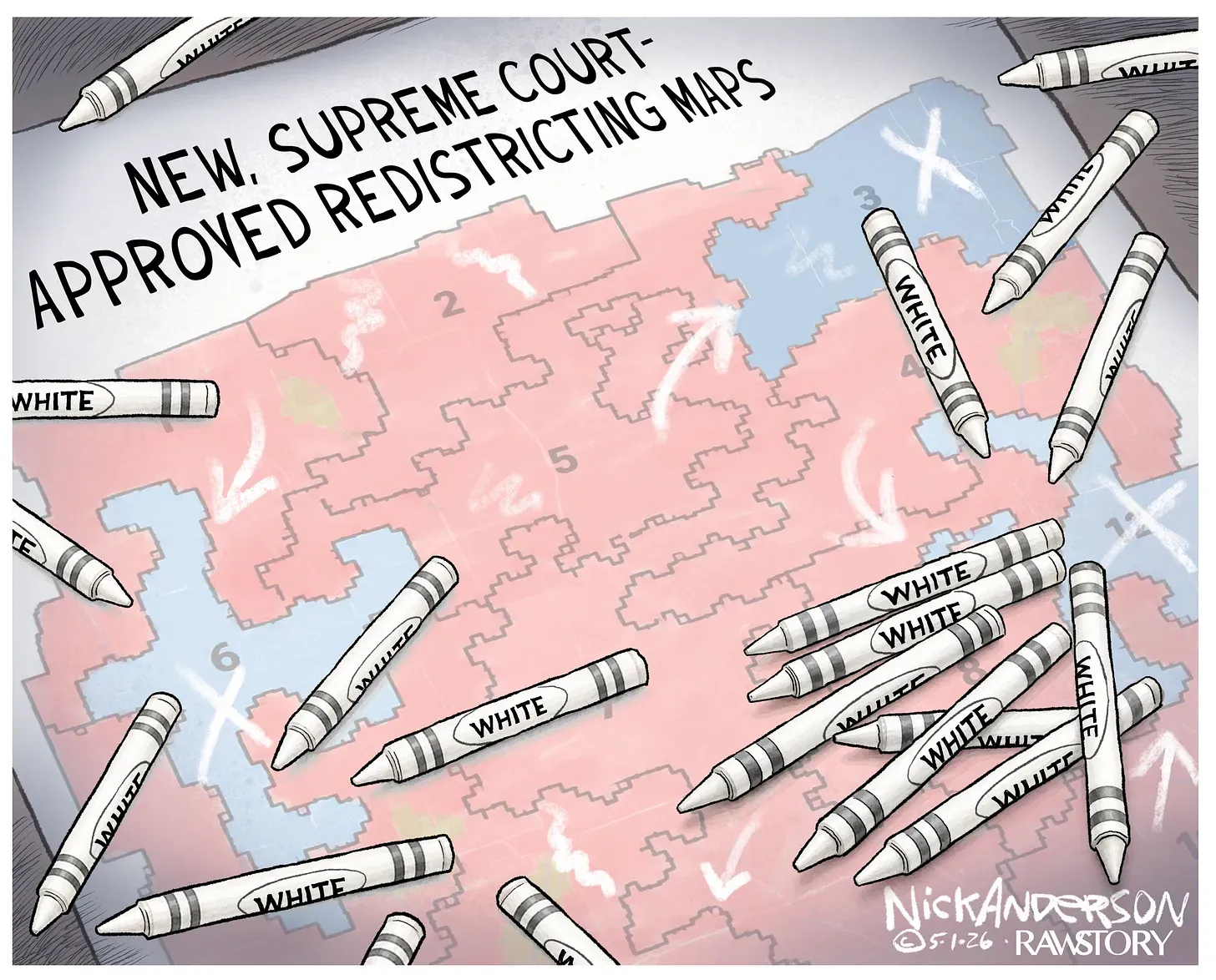
Two of our favorite editorial cartoonists nailed this week’s VRA decision by the Supreme(ly Corrumpted) Court. And Nick Anderson included his thoughts on it.
Steve Greenberg
Nick Anderson
There are Supreme Court decisions that interpret the law, and then there are decisions that demolish it. This week’s ruling on the Voting Rights Act falls squarely in the latter category.
By effectively striking down majority-minority districts as unconstitutional racial gerrymanders, the Court didn’t just tweak precedent. It upended decades of hard-fought protections designed to ensure that minority voters could meaningfully participate in American democracy.
With a stroke of the pen, the Court has effectively kneecapped one of the central tools of the Voting Rights Act — majority-minority districts — on the theory that acknowledging race in a country shaped by race is itself the real offense.
It’s a neat trick. You take a law designed to prevent discrimination, reinterpret it so narrowly that it can barely function, and then congratulate yourself for upholding the Constitution.
The ruling doesn’t remove politics from redistricting. It removes constraints. What remains is a kind of electoral free-for-all, where the only rule is: draw whatever map you can get away with.
Let’s be clear about what that means in practice. For generations, the Voting Rights Act served as a guardrail against the most blatant forms of vote dilution, ensuring that communities historically shut out of power could elect representatives of their choice. Now, those guardrails have been smashed in the name of a sterile, abstract principle: that considering race in redistricting is inherently suspect, even when it’s used to remedy discrimination.
The likely outcome isn’t some principled return to “colorblind” fairness. The ruling enables more surgical precision in cracking and packing voters, only now with a cleaner legal paper trail. Communities that once had a fighting chance to elect candidates of their choice can be sliced apart or submerged, all while everyone insists, with a straight face, that race had nothing to do with it.
The result? A system that pretends not to see race in a country where race has always shaped political power.
Meanwhile, in the real world, politicians didn’t need a legal brief to understand what just happened. The immediate political consequences are already unfolding. Within hours, they were already reaching for the map-drawing crayons like kids tearing open presents on Christmas morning, talking openly about squeezing out more seats (possibly as many as 19) before the ink on the decision is dry.
So let’s dispense with the pretense. This isn’t about ending gerrymandering. It’s about deregulating it.
But the long-term ramifications are far more troubling.
First, this decision accelerates the transformation of redistricting into an all-out arms race. Both parties already gerrymander where they can — especially in the wake of Trump’s mid-decade gerrymandering power grab — but the Voting Rights Act at least imposed some limits rooted in fairness and representation. With those limits weakened, the incentive is simple: draw the most aggressive map you can.
Second, it risks hollowing out representation for minority communities, not through overt suppression, but through dilution. District lines can now be drawn in ways that fracture communities or submerge their voting power, all while maintaining the legal fiction that race played no role.
Third, it deepens public cynicism about the legitimacy of elections. When voters feel that outcomes are predetermined by mapmakers rather than ballots, participation erodes. Democracy becomes less about persuasion and more about engineering.
The damage goes beyond any single election cycle. This decision accelerates the hollowing out of representative democracy itself. When voters begin to suspect—correctly—that maps matter more than votes, participation becomes optional theater. Why show up if the outcome was engineered years in advance?
And then there’s the Court’s role in all of this. For years, it has chipped away at the Voting Rights Act piece by piece. This ruling isn’t a departure. It’s a culmination. The law still exists, technically. It just no longer does what it was designed to do.
And finally, it signals something even more profound about the Court itself. This is not an isolated ruling. It follows a pattern of steadily weakening the Voting Rights Act over the past decade. Each decision chips away at the law’s core promise, replacing it with a narrower vision of equality that is easier to articulate than to live with.
The Court’s defenders will argue that it is simply enforcing the Constitution’s prohibition on racial classifications. But that argument ignores a fundamental truth: sometimes the only way to address inequality is to confront it directly. False notions of “colorblindness,” when applied to a deeply unequal system, don’t produce fairness. They entrench disparity.
We are now entering a new era of American elections. One where the legal tools to challenge discriminatory maps are weaker, the political incentives to exploit that weakness are stronger, and the consequences will be felt for years, if not decades.
The lines on the map are about to change, and with them, so is the meaning of representation itself. No need to repeal a landmark civil rights law when you can simply interpret it into irrelevance.
The lines will be redrawn. Power will shift. And the Court will insist it merely called balls and strikes. Never mind that it quietly moved the foul lines.
Welcome to the new era of American elections.
--30--
Thoughts on this? Leave them in the comments below.
Comments