

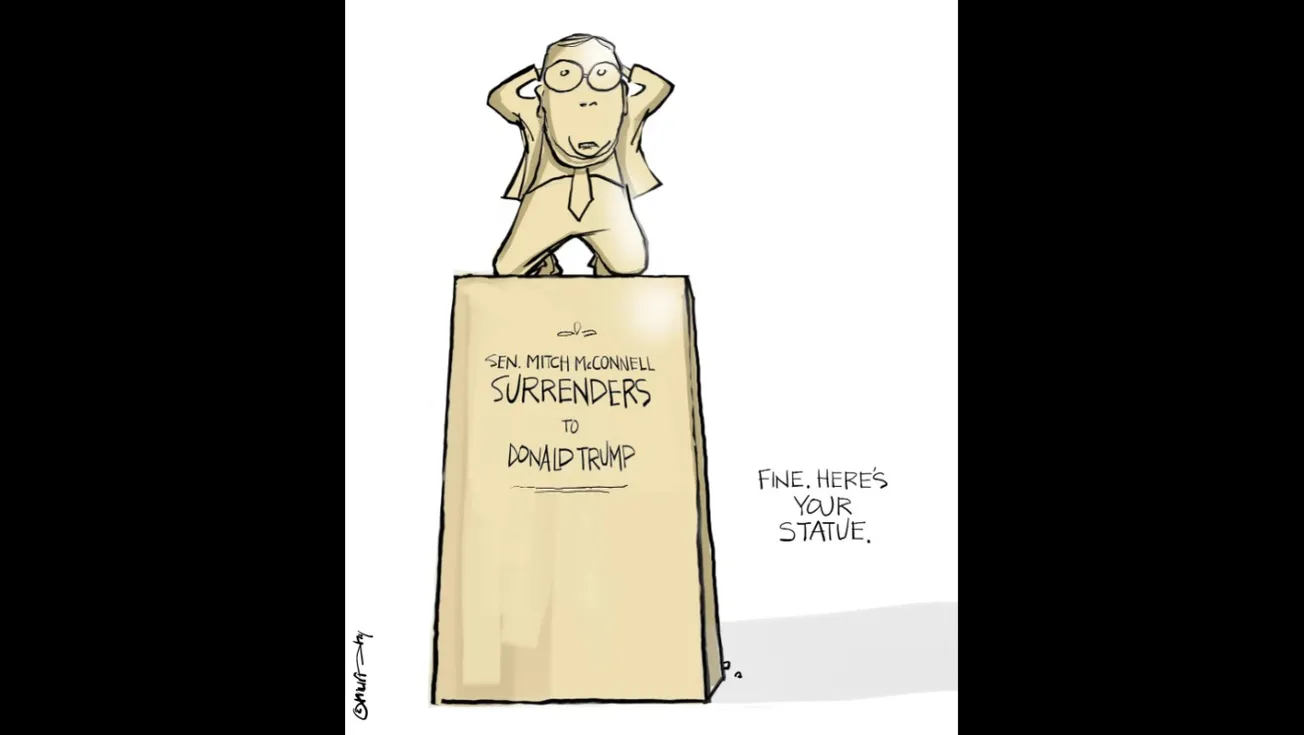
In the final, gasping hours of the 2026 Kentucky General Assembly — via free conference committee — House Bill 757 required “the state curator to accept a statute, monument, or object to art that is privately funded and created depicting or representing United States Senator Addison Mitchell McConnell for display in the New State Capitol rotunda.”
And Senate President Robert Stivers said, “For the last almost 40 years, he’s been the most significant political figure in this state.”
For accuracy in reporting, let us note that after McConnell’s four decades in office, Kentucky ranks 46th out of 50 in Economy, 32nd in Education, 34th in Fiscal Stability, and 45th in Healthcare.
Is this what Stivers calls success?
Nobody asked.
McConnell also had the power after the January 6, 2021 Insurrection to end the MAGA takeover of the Republican Party, and chose not to whip the votes for impeachment.
Was this heroism? Do we build monuments to cowardice?
And yet, none of this is surprising.
Whether they be Majority Leader in the U.S. Senate or a long-serving Kentucky Senate President, what you notice most (and never, ever say out loud) is that rooms go quiet when they enter or speak; other elected officials paint on smiles and give wide berth; questions about their decisions and statements are fewer, shorter, and painstakingly polite; we let them slide.
We tend to have low expectations of elder white men once they reach the highest seats of power.
And we only have to go as far as the Kentucky Senate to witness it.
KYGA 2024
Arguably, the most debated bill of this session was the inaptly-named Safer Kentucky Act (House Bill 5), a sprawling, tough-on-crime, let’s just lock everyone up bill. HB 5 passed as we all knew it would, even as it carried a truckload of controversy, including over where primary sponsor, Rep. Jared Bauman, got the data to support his claims.
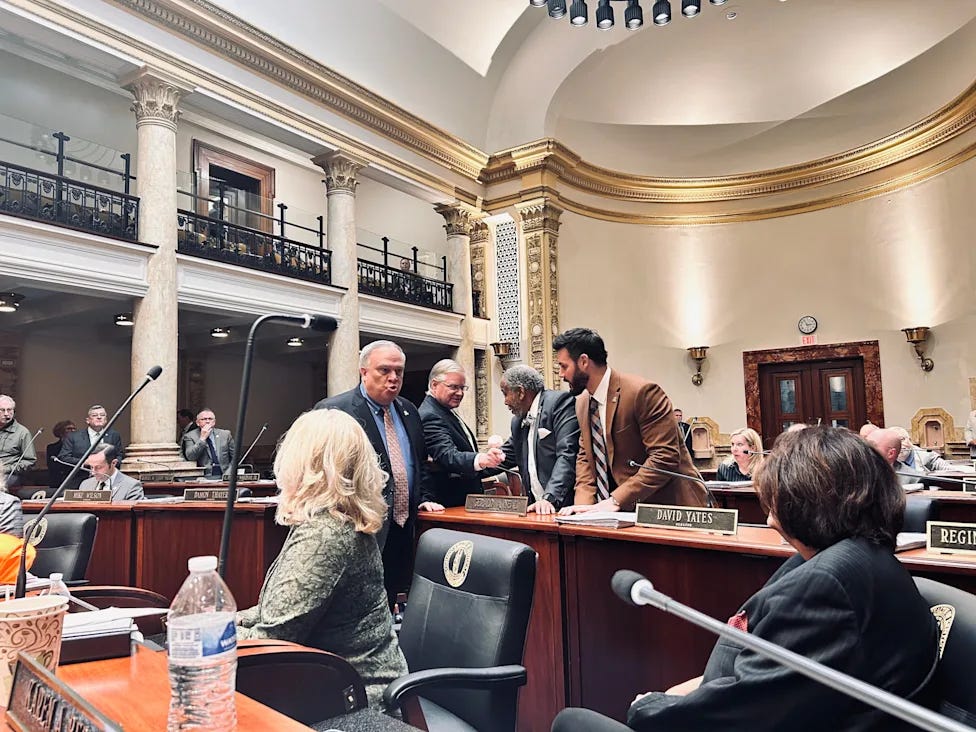
Those questions remained unanswered throughout the session, leading to rising irritation and culminating in the shocking photo of Senate President Robert Stivers losing his temper, right there on the senate floor, at Sen. Karen Berg, who dared — how dare she! — ask real questions.
And then … poof.
Nobody much mentioned it again.
KYGA 2025
In the first week, the House and Senate minority argued that the supermajority’s rules for both chambers would stifle debate and limit their constituents’ voices.
In response, Stivers publicly lamented — right there in the sacred well of the Senate — that reporters might not write the stories he, personally, would most like to see.
“They want to write about division,” Stivers said of the press. “They want to write about dissension. … Every day, I want to look at the people who write the stories, who speak the language, who go on the TVs and the radio to talk about all the positives that this body leans on, not the negatives that they want to sell advertising and get advertising dollars for.”
What was the senate president talking about?
Who knows.
On March 6 of this session, state senator Aaron Reed presented Senate Bill 75 in the Senate Judiciary Committee, to lower the age requirement for carrying a concealed gun from 21 to 18.
Stivers, a member of the committee, explained his yes vote.
“Teenagers fought in the Revolutionary War,” Stiver said, “when our forefathers drafted the Constitution. Nineteen forty-one, December 7th, I know three young men — one 20, one 19, and one 18 — [who] enlisted in the Army because of a tragic event that happened December 7th. One of those was my dad, the other two were my uncles. My uncles stayed from 1941 to 1970, seeing both World War II, Korea, and Vietnam. My dad stayed six years and went into Dachau.”
What does the Revolutionary War, or any war, have to do with civilian firearm safety in 2025?
No one dared to ask.
But Stivers was not finished. He still had the floor. “In 2018,” he said, “I got a call that my 19 year-old son had decided to leave two years of electrical engineering and enlist in the United States Marines, and that May I put him on a bus with [a] twenty dollar bill, a Bible, and his drivers license. I think those instances show that we have, within the recognition of the United States government and the state government, that teenagers are able to defend our country and, therefore, they should be able to purchase a weapon and carry it as any other adult because, at 18, our laws recognize them as such.”
This was a good and patriotic family story — many of us, given a microphone, could tell such stories — but what did it have to do with the present day and allowing 18 to 20 year-old civilians to carry concealed guns?
Not a thing.
And no one asked.
KYGA 2026
During discussion of HB 312 in the Senate Judiciary Committee — again, to allow 18 to 20 year-olds to carry concealed firearms —Stivers made a statement.
“Most of you all know who are in here that I have a son that was 19 years old [when he] went into the Marines,” he said. “I think before age 20 he was a TS 2 which, for people knowing, is top security clearance 2. He was one of the few people in the world that could be armed in the presence of the president because he was attached to the White House detail. And he was 19 years old. I don’t see why he would be disallowed, as the law currently exists, to not do what you’re all advocating what he should be able to do when he can be standing in the presence of the president of the United States, armed, at 19 years old.”
Once again, a good family story. But what does his son being a Marine near the president have to do with civilian teenagers in Kentucky?
Nobody asked.
The United States Marine Corps requires extensive and ongoing firearms training.
Did anyone mention this? Of course not.
On the last day of the 2026 General Assembly, our GOP supermajority censured state Supreme Court Justice Kelly Thompson for portions of his recent opinion regarding a judge’s potential impeachment by the Kentucky Senate.
The “Senate approved a censure resolution sponsored by Senate President Robert Stivers. A few hours later, the House adopted a similar measure filed by House Speaker David Osborne after Republicans blocked any debate on the measure.”
No debate? No discussion? No problem.
They give the Senate President what he wants because they always do. This is how power works. A parting of the seas. No questions asked.
::
There will be a statue of Senator Mitch McConnell erected in Kentucky’s renovated capitol.
Maybe Senate President Robert Stivers would like a statue of his own one day, and why not. Once you have achieved top white-man-in-power status, the sky’s your limit. You can make statements in committee that don’t make a lick of sense and no one will ask if they were germane. You can curl your lip while publicly berating a female senator and the room will go silent. You can chastise the press from the Senate floor and everyone in the room will quietly nod. You can laughably censure a Kentucky Supreme Court justice and block all discussion, and that will be that.
Your possibilities are endless.
No one will blink, lest you take offense.
You’re no DEI hire, after all. You’re an elder white man at the peak of your power. You do as you please.
We commission statues of men like you.
--30--
Comments