


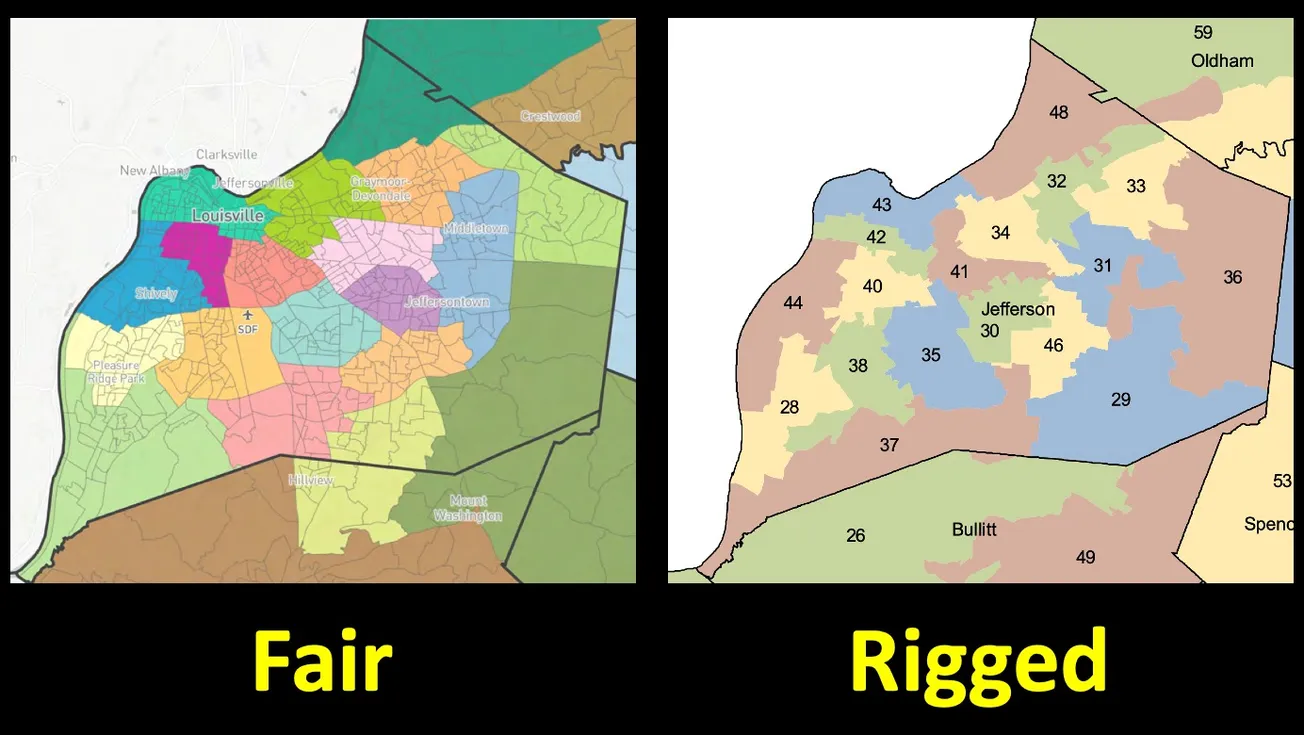
Redistricting has become a hot topic of late. Under the direction of President Trump, states with Republican majority legislatures were urged to undertake mid-census changes to their voting maps.
Before now, redistricting was usually undertaken on a ten-year rotation, following the national census. This made rational sense because the decennial census revealed changes in population movements and locations. With the door open, it may now even be possible for states to redistrict annually, should they choose to do so.
It is somewhat ironic that the U.S. Constitution says virtually nothing about how voting rights are to be distributed amongst the populace. Article I, Section 2 only mandates that “representatives be apportioned among the states based on population.”
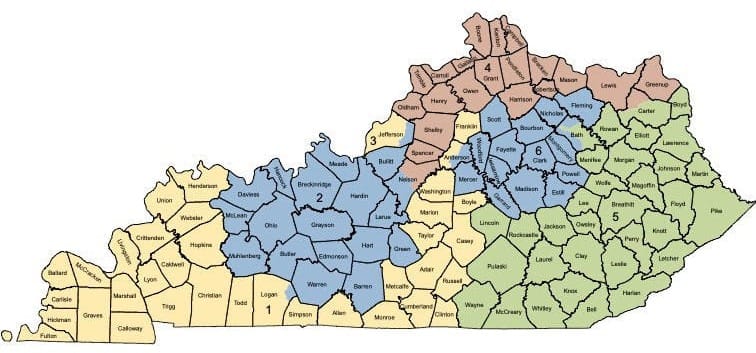
As the district map of Kentucky reveals, “the population” can be spread out in highly subjective ways. That subjective manner is based, in most states, on which party is in power at any given moment because most state constitutions establish the power of districting in the legislature.
As of 2024, only seven states had “independent” commissions responsible for districting: Arizona, California, Colorado, Idaho, Michigan, Montana, and Washington.
The long history of redistricting is rife with corruption. Both the Democratic and Republican parties have been guilty of exploiting the lack of clarity in the laws to pursue their own advantage.
Partisan redistricting really took off following the 2019 ruling of the U.S. Supreme Court in Rucho v. Common Cause, when the 5–4 ruling essentially recognized the faults in districting but concluded that “federal courts are powerless to solve it,” apparently because the Constitution is so vague about the subject.
David Brooks, conservative columnist for various publications including the Wall Street Journal, the New York Times, and The Atlantic, and now a regular commentator on PBS NewsHour, stated the problem very precisely during the May 8th broadcast: “We are stuck in a pseudo-democracy. [Voters] care more about their party than their country…more than democracy.”
That is a sad and frightening conclusion about the battle over districting now, yet it seems horribly accurate.
But it is more than the voters who are at fault. It is easy to see the same malady affecting legislators at both the state and national levels.
At the state level, those legislatures vote to proceed with redistricting at the President’s behest to advantage the party in power.
At the national level, representatives and senators fail to honor their pledge to fairly represent the people by passing federal legislation or by proposing a constitutional amendment.
Since SCOTUS has declared federal courts powerless, it falls to Congress to create fair, honest, and nonpartisan districting requirements based solely on concise, congruent population distributions.
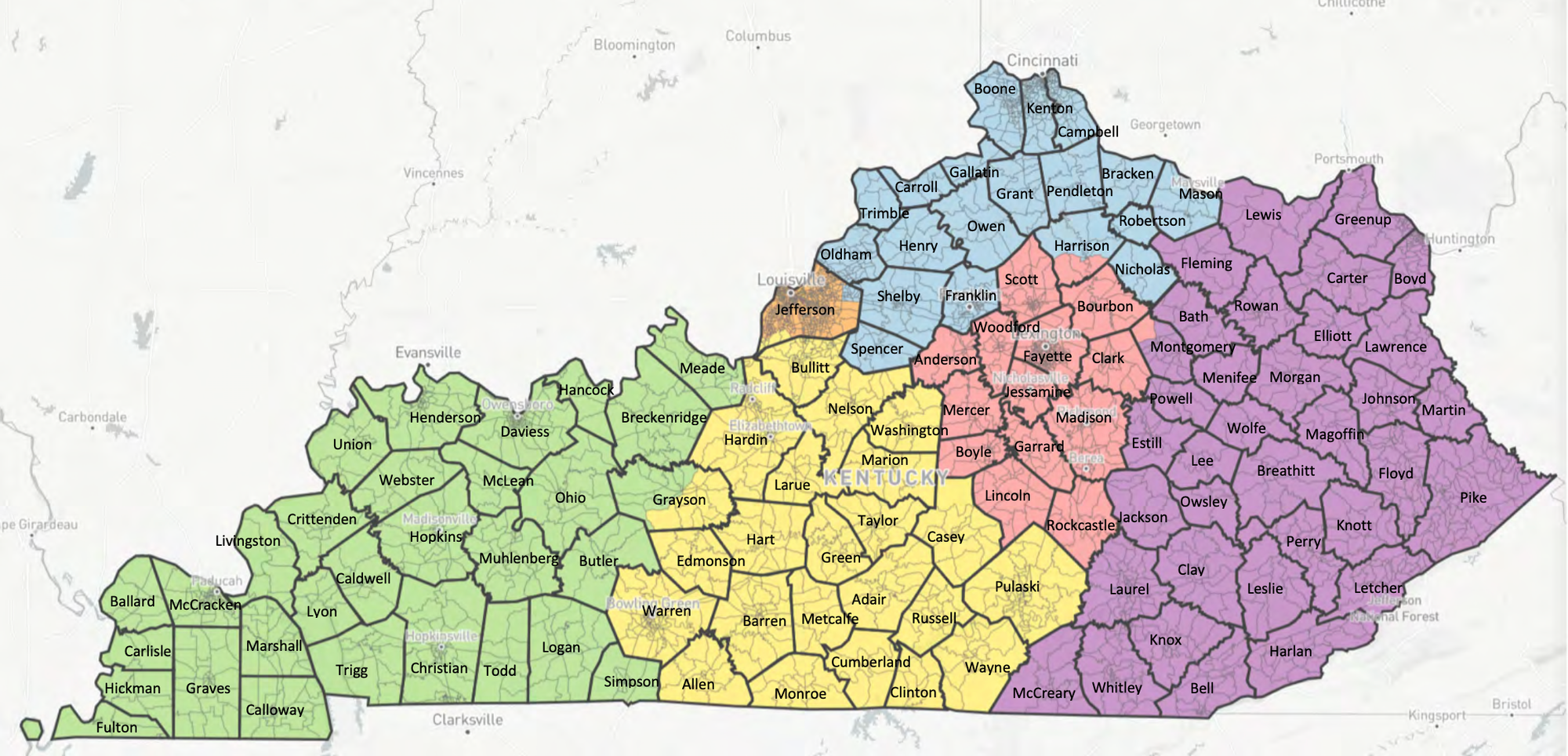
One has only to examine the proposed districting map presented by the League of Women Voters of Kentucky prior to the 2021 adopted map to see how population-based districting can be accomplished.
As long as the power to establish voting districts lies with state legislatures, the maps will always be drawn to favor the party in power, whether Democratic or Republican, rather than the people.
It has been opined that people are no longer choosing their representatives, but rather the other way around.
Regrettably, it seems to be true. And when voters fail to recognize this, democracy dies.
--30--
Written by Chuck Witt, a retired architect, a former newspaper columnist, and a lifelong resident of Winchester. Cross-posted from WinCity Voices.
Comments